

A nursing essay is an academic paper that integrates clinical knowledge, evidence-based research, and professional standards into a structured argument. To write one, you build a thesis from your clinical question or assigned topic, support every claim with peer-reviewed evidence, structure your paragraphs using the PEEL framework (Point, Evidence, Explanation, Link), format the entire paper in APA 7th edition, and connect your argument to professional nursing standards such as the ANA Code of Ethics, the NMC Code, or the NMBA Standards for Practice.
That is the core structure. In practice, most nursing students struggle with the essay, not because they do not understand the clinical content, but because they are writing it between 12-hour clinical shifts, patient care documentation, lab sessions, and study groups. Nursing programs across the US, UK, and Australia report attrition rates of 25-50 percent, and written assignments are consistently where marks are unnecessarily lost. This guide covers every element of a strong nursing essay and includes specific strategies for writing under the time pressure that BSN students face. For nursing students who need support integrating clinical evidence, professional standards, and APA 7 formatting into a well-structured essay, ScribeLab Writer's nursing essay service works with BSN students across the US, UK, Australia, UAE, and internationally.
Quick Answer
A nursing essay requires a clear thesis, evidence from peer-reviewed clinical sources, integration of professional nursing standards, and APA 7th edition formatting. Structure each body paragraph using the PEEL framework: Point (your argument), Evidence (a cited source), Explanation (your analysis of what the evidence means), and Link (a transition to the next paragraph). Use a reflective model such as Gibbs' Reflective Cycle (1988) when the assignment requires reflection on clinical experience. Prioritize writing the body paragraphs first, the introduction second, and the conclusion last. Budget at least one hour for APA formatting and referencing before submission.
What Makes a Nursing Essay Different From a General Academic Essay?
Every academic essay requires a thesis, evidence, and analysis. A nursing essay adds three additional requirements that general essays do not.
Clinical evidence integration. A nursing essay must draw on clinical research, not just academic theory. This means citing randomized controlled trials, systematic reviews, and clinical guidelines from organizations such as the World Health Organization, the Centers for Disease Control and Prevention, and the National Institute for Health and Care Excellence (NICE). General academic essays in the humanities can build arguments solely on theoretical frameworks. Nursing essays cannot.
Professional standards alignment. Your argument must connect to the professional and ethical standards that govern nursing practice. In the US, this is the ANA Code of Ethics for Nurses with Interpretive Statements. In the UK, it is the NMC Code: Professional Standards of Practice and Behavior for Nurses, Midwives and Nursing Associates (2018). In Australia, it is the NMBA Registered Nurse Standards for Practice (2016). Internationally, the ICN Code of Ethics for Nurses (revised 2021) provides a cross-jurisdictional framework. Referencing these standards demonstrates that you can connect academic writing to real-world professional practice.
Patient-centered reasoning. Nursing essays frequently require you to reason from the patient's perspective, considering their preferences, cultural context, and right to informed consent. This patient-centered lens is embedded in every major nursing framework and is a grading criterion in most BSN programs.
If your nursing essay reads like a sociology essay or a psychology essay that happens to mention a patient, you have missed the clinical dimension. The evidence, the standards, and the patient must all be present.
Types of Nursing Essays You Will Encounter
BSN and pre-registration nursing programs assign several distinct essay types. Each has a different purpose and structure, and understanding which one your assignment requires is the first step before you begin writing.
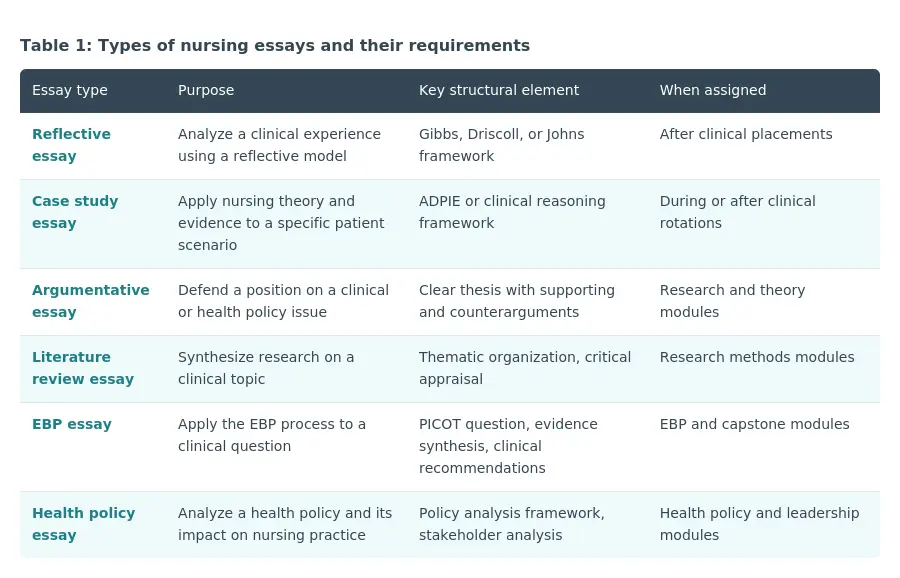
If your assignment brief does not clearly specify which type of essay is expected, check the learning outcomes listed on the brief. Words like "reflect" and "analyze your experience" indicate a reflective essay. Words like "critically evaluate the evidence" indicate a literature review or argumentative essay. Words like "formulate a clinical question" indicate an EBP essay, in which case our guide on how to write a PICOT question with 15 clinical examples covers the foundation you need.
How to Structure a Nursing Essay
The Introduction
Your introduction does three things in one paragraph:
Opens with context that leads to the clinical problem or topic, not a dictionary definition, and not "since the beginning of time"
State your thesis, which is the specific argument your essay will prove
Briefly previews the structure of the essay
Weak introduction opener: "The nursing profession has always been important to healthcare."
Strong introduction opener: "Despite evidence that early mobilization reduces the incidence of deep vein thrombosis in post-surgical patients by up to 50 percent (Liu et al., 2021), clinical practice on many surgical wards continues to prioritize bed rest during the first 24 hours following surgery."
The strong version introduces a specific clinical problem, cites a specific source, and creates a natural entry point for a thesis about evidence-practice gaps.
Body Paragraphs Using PEEL
Each body paragraph should follow the PEEL framework:
P - Point: State the main argument of the paragraph in one sentence. This is your topic sentence.
E - Evidence: Provide evidence from a peer-reviewed source. Cite it in APA 7th edition format. If you need guidance on verifying whether your source meets peer-review standards, our guide on identifying peer-reviewed sources covers five checks that work across every database.
E - Explanation: Analyze what the evidence means. This is where most nursing students lose marks. Do not just quote or paraphrase the source. Explain what it means for your argument, identify its limitations, and connect it to the broader body of evidence.
L - Link: Transition to the next paragraph. This sentence shows how the current point connects to the next one, maintaining the logical flow of your argument.
Example of a weak body paragraph: "Hand hygiene is important in hospitals. According to the WHO (2009), hand hygiene reduces the risk of infection. Nurses should wash their hands."
Example of a strong PEEL body paragraph: "Alcohol-based hand rub protocols have been shown to reduce healthcare-associated infection rates more effectively than soap-and-water handwashing alone (Pittet et al., 2000; WHO, 2009). A systematic review by Luangasanatip et al. (2015) found that multimodal hand hygiene interventions, which combined education, reminders, and feedback, achieved sustained improvements in compliance rates of up to 20 percentage points. However, compliance rates in the studies reviewed varied substantially depending on staff workload and organizational culture, suggesting that individual behavior change is insufficient without systemic support. This aligns with the NMC Code (2018) requirement that nurses take all reasonable personal precautions to avoid potential health risks to colleagues, people receiving care, and the public (Standard 19.4), positioning hand hygiene not as a discretionary clinical preference but as a professional obligation.
The second version has a point, two pieces of evidence with citations, a critical analysis of the evidence's limitations, and a direct connection to a professional standard.
The Conclusion
Your conclusion should not repeat the introduction. It should:
Synthesize the main findings from your body paragraphs into a final, coherent argument
Address the implications for nursing practice, asking, "So what does this mean for patient care?"
Identify areas for future research or practice development
A strong conclusion adds value. It does not summarize.
Writing your nursing essay between 12-hour clinical shifts and running out of time? |
|---|
Integrating peer-reviewed clinical evidence, connecting every argument to professional standards such as the NMC Code or ANA Code of Ethics, applying PEEL structure consistently across every paragraph, and formatting the entire paper in APA 7 requires focused academic time that is hard to find during clinical placement weeks. ScribeLab Writer's nursing essay service works with BSN nursing students across the US, UK, Australia, UAE, and internationally to deliver fully referenced, evidence-integrated nursing essays on your deadline. |
Reflective Writing Models for Nursing Essays
Many nursing essay assignments require reflection on clinical experience. Three models are most commonly taught in nursing programs worldwide.
Gibbs' Reflective Cycle (1988)
Developed by Graham Gibbs in Learning by Doing: A Guide to Teaching and Learning Methods (Further Education Unit, Oxford Polytechnic, 1988), this six-stage model is the most widely used reflective framework in UK and Australian nursing education.
The six stages are:
Description - What happened during the clinical experience? State the facts without interpretation.
Feelings - How did you feel at the time? How do you feel now, looking back?
Evaluation - What went well? What did not go well?
Analysis - Why did things go the way they did? What does the literature say about similar situations?
Conclusion - What did you learn? What could you have done differently?
Action plan - What will you do differently next time in a similar clinical situation?
The most common mistake is spending 80 percent of the essay on Stage 1 (description) and rushing through Stages 4-6 (analysis, conclusion, action plan). Your professor is grading the analysis and the action plan, not the description. As a rule, description should be no more than 20 percent of your essay. The remaining 80 percent should be evaluation, analysis, and action planning, supported by evidence.
Driscoll's Model of Reflection (What? So What? Now What?)
Derived from Borton (1970) and developed by John Driscoll (1994, 2000, 2007), this three-stage model is simpler than Gibbs and is sometimes preferred for shorter reflective assignments.
What? - A description of the event
So what? - An analysis of why it matters, what you learned, and what the literature says
Now what? - An action plan for future practice
John's Model for Structured Reflection (2000/2006)
Christopher Johns' model uses a series of guided questions organized around five cue areas: description, reflection, influencing factors, alternative strategies, and learning. It is more structured than Gibbs and is used in programs that emphasize guided reflective practice.
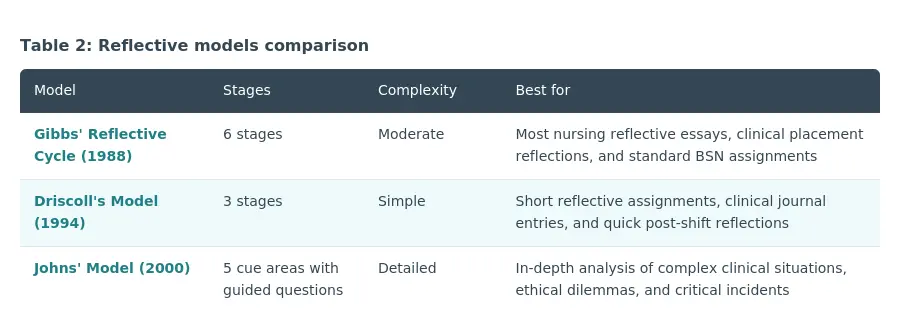
Your assignment brief usually specifies which model to use. If it does not, Gibbs is the safest default because it is the most widely recognized and accepted internationally among nursing programs.
How to Integrate Evidence-Based Practice Into Your Nursing Essay
Every claim in your nursing essay needs evidence. But not all evidence carries the same weight. Understanding the hierarchy of evidence helps you choose the strongest sources for your argument.
The evidence hierarchy used in nursing (from Melnyk and Fineout-Overholt's Evidence-Based Practice in Nursing and Healthcare) ranks evidence on seven levels:
Level I: Systematic reviews and meta-analyses of randomized controlled trials
Level II: Well-designed randomized controlled trials
Level III: Controlled trials without randomization
Level IV: Case-control and cohort studies
Level V: Systematic reviews of qualitative or descriptive studies
Level VI: Single qualitative or descriptive studies
Level VII: Expert opinion
When writing your nursing essay, aim to cite Level I and Level II evidence for your strongest claims. Use Level VI and VII evidence for context and background, but do not build your central argument on expert opinion alone when higher-level evidence exists.
This evidence hierarchy is the same one used in the evidence-based practice process. If your nursing program requires an EBP assignment, the clinical question formulation stage starts with a well-built PICOT question. If your care plan assignment requires you to justify your interventions with evidence, our step-by-step guide on how to write a nursing care plan with NANDA examples covers how to write evidence-based rationales for every intervention.
APA 7th Edition Formatting for Nursing Essays
Most nursing programs in the US, and many internationally, require APA 7th edition formatting. Here are the key elements you need to get right.
Title page (student version):
Paper title in bold, centered, 3 to 4 lines down from the top
Your name
Your university and department
Course number and name
Instructor name
Assignment due date
Page number top right on every page, including the title page
Important APA 7 change: Student papers do NOT require a running head. This changed from the APA 6th edition. If your textbook is from before 2020, it may still tell you to include one. Check with your instructor, but the APA 7 standard does not require a running head for student papers.
In-text citations:
Paraphrase: (Author, Year)
Direct quote: (Author, Year, p. #)
Two authors: (Smith & Jones, 2023)
Three or more authors: (Smith et al., 2023) from the first citation
Reference list:
New page, "References" centered and bold
Hanging indent, double-spaced, alphabetical by first author's last name
DOIs formatted as URLs: https://doi.org/xxxxx
No "Retrieved from" before URLs (APA 7 dropped this)
Citing clinical guidelines in APA 7:
WHO: World Health Organization. (Year). Title of guideline. https://url
CDC: Centers for Disease Control and Prevention. (Year). Title. https://url
NICE: National Institute for Health and Care Excellence. (Year). Title (NICE guideline [NGxxx]). https://url
NMC Code: Nursing and Midwifery Council. (2018). The code: Professional standards of practice and behavior for nurses, midwives and nursing associates. https://www.nmc.org.uk/standards/code/
For a complete guide to citing websites, government reports, and clinical guidelines across APA, MLA, Chicago, and Harvard with worked examples for every edge case, see our citation formatting guide.
Time Management for Nursing Students
If you are behind on your essay because clinical placements have consumed all your time, here is a realistic strategy that accounts for the fact that you cannot write for 8 uninterrupted hours the way other students might.
The 5-Day Nursing Essay Plan
Day 1 (45 minutes): Read the brief and build a skeleton outline. Read the assignment brief three times. Identify exactly what is being asked. Write a one-sentence thesis. Create a paragraph outline: one row per paragraph with the point you will make and the source that supports it. This is your roadmap, helping prevent wasted writing time.
Day 2 (90 minutes): Write the body paragraphs. Write the body paragraphs first, not the introduction. Use the PEEL structure for each one. Do not worry about perfection. Get the arguments down with citations.
Day 3 (60 minutes): Write the introduction and conclusion. The introduction is easier to write once the body is in place, because you know what the essay actually argues. The conclusion synthesizes, it does not summarize.
Day 4 (45 minutes): Add citations and build the reference list. Go through every in-text citation and add the full reference to the reference list. Check that every in-text citation has a matching reference and vice versa. Use your university's APA guide or the Purdue OWL to verify formatting.
Day 5 (30 minutes): Proofread and format. Read the essay aloud once. Fix anything that sounds wrong. Check margins (1 inch), font (12pt Times New Roman or 11pt Calibri), spacing (double), and page numbers. Check word count. Submit.
Total time: approximately 4.5 hours across 5 days. Each session fits into a gap between clinical shifts.
Professional and Ethical Frameworks to Reference
Depending on where you are studying and which professional standards your program follows, these are the frameworks you should cite when connecting your essay to professional nursing practice.
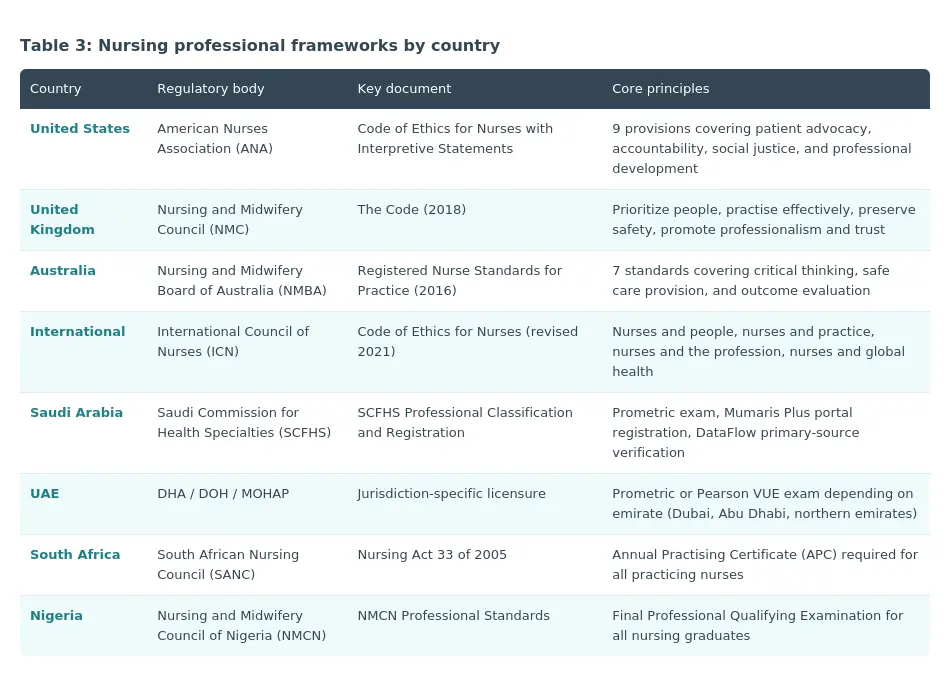
When citing a professional standard, name the specific section or provision that relates to your argument. "The NMC Code states that nurses should provide safe care" is too vague. "The NMC Code (2018, Standard 6.2) requires nurses to 'make sure that any information or advice given is evidence-based, including information relating to using any health and care products or services'" is specific and demonstrates professional knowledge.
Common Mistakes in Nursing Essays
Pure Description Without Analysis
Describing what happened in a clinical scenario or what a source says without explaining what it means is the single most common reason nursing essays receive low marks. Every time you cite a source, follow it with analysis: What does this evidence mean for your argument? What are its limitations? How does it connect to other evidence?
No Connection to Professional Standards
A nursing essay that reads like a generic health sciences essay is missing a key element. Your argument should connect explicitly to the professional standards that govern nursing practice in your country. This is a grading criterion in most nursing programs and an expectation that distinguishes nursing writing from other health disciplines.
Vague or Absent Reflective Analysis
In reflective essays, spending most of the word count describing the clinical event and rushing the analysis are extremely common patterns. Your professor has seen the clinical scenario before. They want to see what you learned from it, how it connects to the literature, and what you would do differently. Description should be no more than 20 percent of a reflective essay.
Outdated or Non-Peer-Reviewed Sources
Using textbook summaries, lecture slides, or non-peer-reviewed websites as primary evidence weakens your argument. Aim for peer-reviewed journal articles published within the last 5 to 7 years for clinical evidence. Foundational texts and professional standards documents are exempt from the currency requirement.
APA Formatting Errors
Missing in-text citations, reference list entries that do not match in-text citations, incorrect DOI formatting, and including a running head on a student paper when APA 7 no longer requires one are all common errors. These are preventable with a 30-minute formatting check before submission.
Frequently Asked Questions About Nursing Essays
Which reflective model should I use?
Use the model your assignment specifies. If none is specified, Gibbs' Reflective Cycle (1988) is the safest default because it is the most widely recognized across international nursing programs. Use Driscoll's model for shorter assignments and Johns' model for in-depth analysis of complex clinical situations.
How do I reference the NMC Code in APA?
Cite it as: Nursing and Midwifery Council. (2018). The code: Professional standards of practice and behavior for nurses, midwives and nursing associates. https://www.nmc.org.uk/standards/code/. In-text, cite as (Nursing and Midwifery Council, 2018) or (NMC, 2018) if you have already introduced the abbreviation.
How many sources should I cite in a nursing essay?
There is no universal rule, but a strong 2,000-word nursing essay typically cites 10 to 15 sources. A 3,000-word essay cites 15 to 25. The quality and relevance of the sources matter more than the number. Your instructor may specify a minimum.
Can I use the first person in a nursing essay?
In reflective essays, yes. First person ("I observed," "I felt") is expected because you are analyzing your own clinical experience. In argumentative and literature review essays, most nursing programs prefer the third person unless your instructor states otherwise. Check your assignment brief.
How do I integrate clinical guidelines into my argument?
Cite the guideline as a source and use it to support or contextualize your argument. For example: "The NICE guideline on falls prevention in older people (NICE, 2013) recommends multifactorial risk assessment for all patients aged 65 and over presenting to healthcare settings, supporting the implementation of a standardized falls risk assessment tool on the ward." Always cite the specific guideline number or title.
How current should my sources be?
For clinical evidence, aim for the last 5 to 7 years. For professional standards and foundational nursing theory, use the current edition regardless of publication date. The NMC Code (2018), the ANA Code of Ethics, and the NANDA-I 13th edition (2024 to 2026) are all current references that should be used as published.
What is the difference between a nursing essay and a nursing care plan?
A nursing essay is a structured academic argument supported by evidence and formatted as continuous prose. A nursing care plan is a clinical document structured around the ADPIE framework (Assessment, Diagnosis, Planning, Implementation, Evaluation) with specific NANDA-I diagnoses, SMART goals, and interventions with rationales. Both are assessed in nursing programs, but they serve different purposes and follow different formats. For detailed guidance on care plans, see our guide on how to write a nursing care plan with NANDA examples.
You May Also Find Useful
Nursing essays are where clinical knowledge meets academic writing. The content is not the hard part for most nursing students. The structure, the integration of evidence, the reflective analysis, and the APA formatting are where marks are gained or lost. Master the PEEL framework for body paragraphs, use a reflective model as your ready-made outline for reflective assignments, and budget your last hour for citation checking and formatting.
If you are a nursing student balancing clinical placements with written assignments and need support with essay structure, APA formatting, or evidence integration, ScribeLabWriter's nursing writing service works with BSN and MSN students across the US, UK, Australia, and internationally.