

A PICOT question converts a clinical information need into a structured, searchable question that guides an evidence-based practice search. To write one, identify your Patient or Population (P), the Intervention you are examining (I), the Comparison intervention or standard care (C), the Outcome you want to measure (O), and the Time frame for measuring that outcome (T). The resulting question follows the template: "In [P], how does [I] compared to [C] affect [O] within [T]?"
That is the core framework. In practice, getting each component right, choosing between PICO and PICOT, avoiding the most common mistakes, and then using your question to drive an effective database search requires more than a template. This guide covers every part of the process, with 15 fully worked examples across nursing specialties so you can apply it directly to your own assignment, capstone, or EBP paper. For BSN and MSN nursing students who need support formulating a PICOT question or developing the full EBP paper or capstone project that follows from it, ScribeLab Writer's nursing writing service works with students across the US, UK, Australia, UAE, and internationally.
Quick Answer:
A PICOT question is the clinical question framework used in evidence-based nursing practice. Each letter represents a component: Patient or Population (P), Intervention (I), Comparison (C), Outcome (O), and Time (T). To write one, identify your clinical problem, narrow each component precisely, then assemble them using the standard template: "In [P], how does [I] compared to [C] affect [O] within [T]?" Use CINAHL and PubMed as your primary databases. Each PICOT component becomes a set of search terms. PICO is used when there is no time frame; SPIDER is used for qualitative questions about experiences or meaning.
What Is a PICOT Question?
A PICOT question is the clinical question formulation tool used in evidence-based practice (EBP) to structure a searchable, answerable question from a patient care problem. The framework was introduced by Richardson, Wilson, Nishikawa, and Hayward in 1995 in the ACP Journal Club, where they described the "well-built clinical question" as essential to evidence-based decision making. The original formulation used four components and was known as PICO. The T for time was added by subsequent authors to capture interventions with measurable time horizons.
According to Gallagher-Ford and Melnyk (2019), writing in Worldviews on Evidence-Based Nursing, the PICOT question is the "underappreciated and misunderstood step" of the EBP process: underappreciated because many clinicians skip it or rush it, and misunderstood because students often confuse a general research question with a well-built clinical question. A well-built PICOT question does two things: it narrows the scope of the search so you retrieve relevant studies rather than thousands of loosely related papers, and it defines the outcome clearly enough that you can judge whether the evidence addresses it.
What Does Each Letter in PICOT Stand For?
Each component has a precise meaning that shapes what you search for and what evidence you consider relevant.
Table 1: PICOT Framework: Components, Definitions, and Guiding Questions
Component | Stands For | Definition | Guiding Question |
|---|---|---|---|
P | Patient, Population, or Problem | The specific group of patients or the clinical problem you are addressing | Who are my patients? What is their condition, age, setting, or defining characteristic? |
I | Intervention | The specific treatment, therapy, screening tool, nursing action, or exposure you are examining | What do I plan to do? What is the specific action being tested? |
C | Comparison | The alternative to the intervention, such as standard care, a placebo, a different treatment, or no treatment | What is the main alternative? What are we comparing the intervention against? |
O | Outcome | The measurable result you want to achieve or the effect you want to evaluate | What do I want to accomplish, measure, improve, or affect? |
T | Time | The duration over which the outcome is measured or the timeframe of the intervention | How long does it take for the intervention to produce the outcome? |
A note on the C component: not every PICOT question has an explicit comparison. In some foreground questions, particularly those about prognosis, meaning, or experience, there is no intervention to compare against. In those cases, you can omit C or note "no intervention / standard care," and the question becomes a PICO question.
PICO vs. PICOT vs. PICOTS vs. SPIDER: When to Use Each
Using the right framework for your question type is essential. The PICOT framework was designed for intervention and therapy questions. Other question types require adjusted frameworks.
Table 2: PICOT Framework Variants and When to Use Each
Framework | Best For | Key Difference | Example Question Type |
|---|---|---|---|
PICO | Foundational therapy and intervention questions with no fixed time frame | No time component | Does hand hygiene reduce HAIs? |
PICOT | Intervention questions with a measurable time horizon | Adds T for time | Does chlorhexidine bathing reduce CLABSI within 30 days? |
PICOTS | Systematic reviews requiring specific study design filters | Adds S for Study design | What RCTs examine fall prevention in elderly inpatients? |
SPIDER | Qualitative or mixed-methods questions | Replaces PICO components: Sample, Phenomenon of Interest, Design, Evaluation, Research type | What is the lived experience of chronic pain in adult cancer patients? |
The SPIDER framework was developed by Cooke, Smith, and Booth (2012) in Qualitative Health Research specifically because PICO's intervention and comparison components do not map onto qualitative questions. If your capstone or dissertation uses a qualitative approach such as phenomenology, grounded theory, or thematic analysis, SPIDER is the appropriate framework. Most US BSN programs use PICOT as the default. UK and Australian programs that include qualitative EBP modules are more likely to introduce SPIDER alongside PICOT.
You May Also Find Useful
How to Write a PICOT Question Step by Step
Step 1: Start With the Clinical Problem
Begin with the scenario you are working from, not an abstract topic. A good starting point is a clinical question that arose from patient care: something you observed on placement, a care gap identified in your course materials, or a problem your instructor has framed in an assignment scenario.
Write a single sentence describing the problem: "I have a patient who is a 65-year-old woman with type 2 diabetes who is not adhering to her oral medication regimen. I want to know whether text-message reminders improve adherence compared to standard follow-up."
Step 2: Identify Your Population
Narrow your population to the specific group that is clinically meaningful. "Adults" is too broad. "Adults with type 2 diabetes in outpatient primary care settings" is specific enough to retrieve relevant evidence without excluding studies that apply to your population. Include age group, diagnosis, care setting, and any other defining characteristics.
Step 3: Define Your Intervention Precisely
The intervention must be specific enough to search for. "Exercise" is too vague. "A structured nurse-led 12-week exercise program" is searchable and testable. If you are examining a pharmacological intervention, include the drug class or specific drug. If you are examining a nursing protocol, name it.
Step 4: Identify the Comparison
Ask: What is the current standard of care, or what is the intervention being compared against? In many clinical questions, the comparison is "standard care" or "usual practice." In pharmacological questions, it may be a specific alternative drug or a placebo. If no comparison is clinically meaningful, omit this component and use PICO.
Step 5: Specify a Measurable Outcome
Your outcome must be measurable and clinically meaningful. Avoid vague outcomes like "improved health" or "better outcomes." Choose specific, validated measures: HbA1c levels, pain scores on the Numeric Rating Scale, hospital readmission rates, patient satisfaction scores, fall rates, or infection rates. Using a validated outcome measure strengthens the quality of your evidence search and makes your EBP paper more credible.
Step 6: Add a Time Frame (if applicable)
Ask: over what period would you expect to see a measurable difference? This is often stated as weeks or months, which is the length of the study or intervention. Not every question has a natural time frame; foreground questions about etiology or meaning often do not. If in doubt, include it only if it genuinely affects what studies you would consider relevant.
Step 7: Assemble and Test the Question
Use the standard template: "In [P], how does [I] compared to [C] affect [O] within [T]?"
Test it: can you search for it in PubMed or CINAHL? Could a peer reviewer identify what outcome you are measuring? Is it specific enough to exclude irrelevant studies? If the answer to any of those is no, revise one component.
Working on your PICOT question and unsure which framework applies to your clinical scenario? |
|---|
Choosing between PICO, PICOT, PICOTS, and SPIDER, then ensuring each component is specific enough to drive a reproducible database search while meeting your assignment rubric or capstone committee's formatting requirements, is harder in practice than any comparison table captures. ScribeLab Writer's nursing writing service works with BSN and MSN students to formulate PICOT questions, build CINAHL and PubMed search strategies, and develop full EBP papers and capstone projects to AACN standards across the US, UK, Australia, UAE, and internationally. |
15 Fully Worked PICOT Question Examples Across Nursing Specialties
Each example below shows the clinical scenario, the breakdown by component, and the assembled question.
1. Hand Hygiene and Healthcare-Associated Infections
Clinical scenario: You are working on a general medical ward and want to know whether alcohol-based hand rubs are more effective than soap and water at reducing healthcare-associated infections (HAIs).
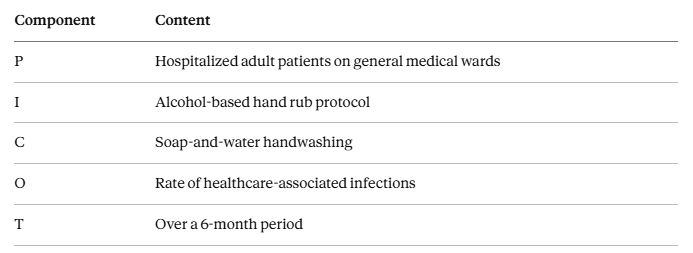
PICOT question: In hospitalized adult patients on general medical wards (P), how does an alcohol-based hand rub protocol (I), compared to soap-and-water handwashing (C), affect the rate of healthcare-associated infections (O) over a 6-month period (T)?
2. Fall Prevention in Elderly Inpatients
Clinical scenario: Your placement is on a geriatric ward. Falls are a major concern. You want to know if hourly nursing rounds reduce falls compared to standard call-bell-only response.
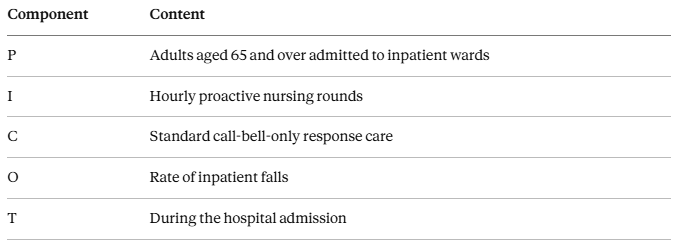
PICOT question: In adults aged 65 and over admitted to inpatient wards (P), how do hourly proactive nursing rounds (I) compared to standard call-bell care (C) affect the rate of inpatient falls (O) during hospital admission (T)?
3. Pressure Injury Prevention in ICU Patients
Clinical scenario: You are on an ICU placement and notice an inconsistency in repositioning schedules for immobile patients.
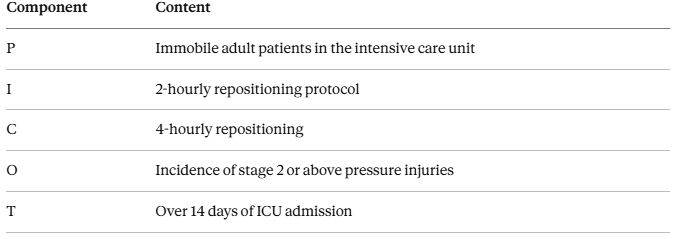
PICOT question: In immobile adult patients in the ICU (P), does 2-hourly repositioning (I) compared to 4-hourly repositioning (C) reduce the incidence of stage 2 or above pressure injuries (O) over 14 days of admission (T)?
4. Medication Adherence in Hypertensive Patients
Clinical scenario: Your public health module requires an EBP paper on improving antihypertensive medication adherence in primary care.
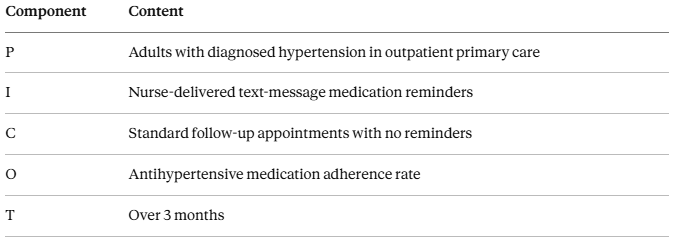
PICOT question: In adults with hypertension in outpatient primary care (P), how do nurse-delivered text-message medication reminders (I), compared to standard follow-up (C), affect antihypertensive adherence (O) over 3 months (T)?
5. Multimodal Pain Management Post-Surgery
Clinical scenario: You are working in a surgical unit and want to evaluate whether multimodal analgesia reduces post-operative pain compared to opioid-only protocols.
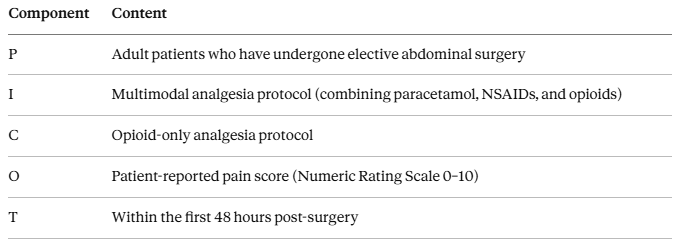
PICOT question: In adults post-elective abdominal surgery (P), does multimodal analgesia (I) compared to opioid-only analgesia (C) reduce patient-reported NRS pain scores (O) within 48 hours (T)?
6. Depression Screening in Primary Care
Clinical scenario: Your community nursing module focuses on identifying untreated depression in adult primary care patients.
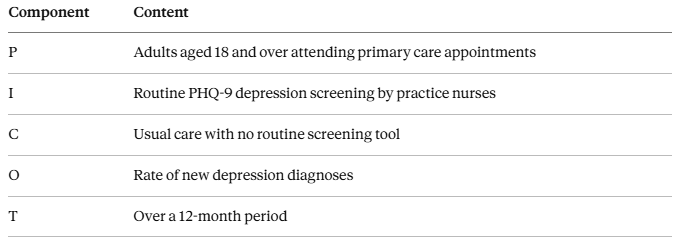
PICOT question: In adults aged 18 and over attending primary care (P), does routine PHQ-9 screening by practice nurses (I) compared to usual care (C) increase the rate of new depression diagnoses (O) over 12 months (T)?
7. Pre-operative Anxiety Reduction
Clinical scenario: Your surgical nursing module asks you to find evidence for non-pharmacological anxiety management before surgery.
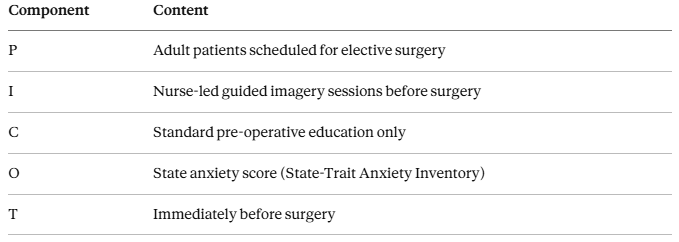
PICOT question: In adults scheduled for elective surgery (P), does nurse-led guided imagery (I), compared to standard pre-operative education (C), reduce state anxiety scores on the STAI (O) immediately before surgery (T)?
8. Asthma Management in Pediatric Patients
Clinical scenario: Your pediatric nursing placement raises questions about reducing emergency department returns in children with asthma.
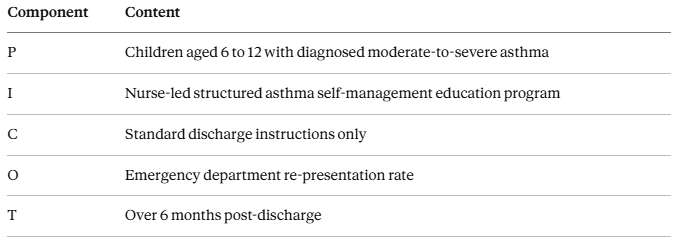
PICOT question: In children aged 6 to 12 with moderate-to-severe asthma (P), does a nurse-led self-management education program (I) compared to standard discharge instructions (C) reduce ED re-presentations (O) over 6 months (T)?
9. Ventilator-Associated Pneumonia Prevention
Clinical scenario: Your critical care elective focuses on infection control in mechanically ventilated patients.

PICOT question: In adult patients mechanically ventilated in the ICU (P), does a nurse-implemented ventilator care bundle (I), compared to standard ventilator care (C), reduce the incidence of ventilator-associated pneumonia (O) during ICU admission (T)?
10. Diabetes Screening in Underserved Communities
Clinical scenario: Your community health module asks you to examine equity in diabetes screening access.
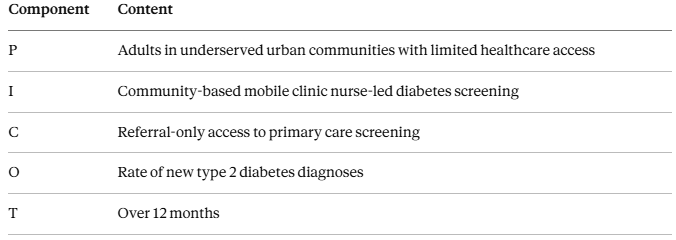
PICOT question: In adults in underserved urban communities (P), does community-based mobile clinic screening by nurses (I) compared to referral-only care (C) increase new type 2 diabetes diagnoses (O) over 12 months (T)?
11. Breastfeeding Initiation and Skin-to-Skin Contact
Clinical scenario: Your maternity nursing module focuses on evidence-based practices for supporting breastfeeding initiation.
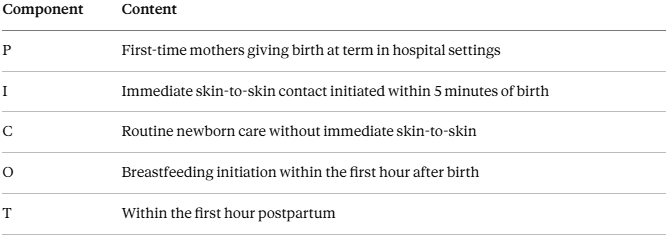
PICOT question: In first-time mothers giving birth at term (P), does immediate skin-to-skin contact within 5 minutes of birth (I), compared to routine newborn care (C), improve breastfeeding initiation rates (O) within the first hour postpartum (T)?
12. HbA1c Improvement Through Structured Self-Management Education
Clinical scenario: Your chronic disease management placement focuses on nurse-led education for patients with type 2 diabetes.
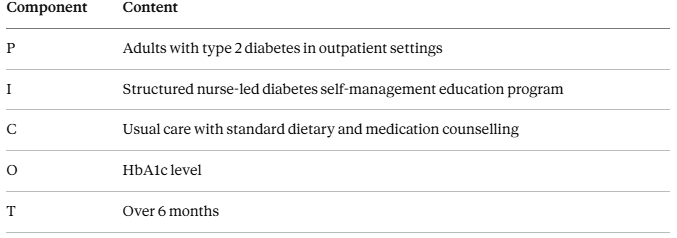
PICOT question: In adults with type 2 diabetes in outpatient settings (P), does structured nurse-led self-management education (I), compared to usual care (C), lower HbA1c levels (O) over 6 months (T)?
13. Telemonitoring and Heart Failure Readmissions
Clinical scenario: Your cardiac nursing module requires you to examine remote monitoring strategies for reducing hospital readmissions in heart failure patients.
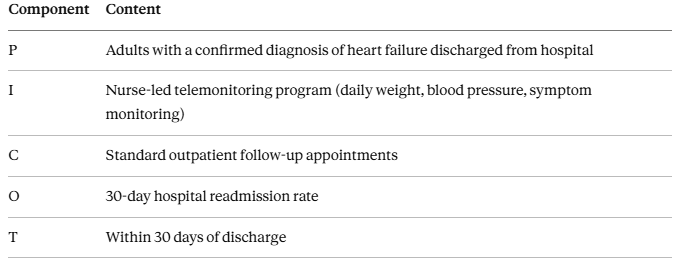
PICOT question: In adults with heart failure discharged from hospital (P), does a nurse-led telemonitoring program (I) compared to standard outpatient follow-up (C) reduce 30-day readmission rates (O) within 30 days of discharge (T)?
14. Exercise and Falls in Nursing Home Residents
Clinical scenario: Your aged care elective raises questions about physical activity programs for reducing falls in nursing home residents.
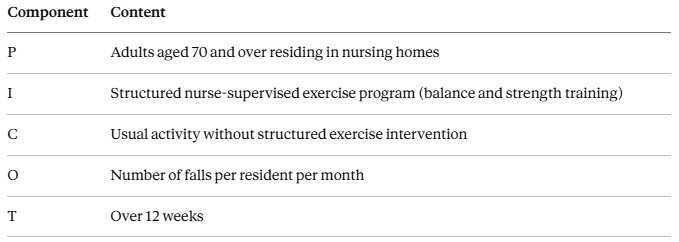
PICOT question: In adults aged 70 and over residing in nursing homes (P), does a structured nurse-supervised exercise program (I) compared to usual activity (C) reduce falls per resident per month (O) over 12 weeks (T)?
15. Scalp Cooling and Chemotherapy-Induced Alopecia
Clinical scenario: Your oncology nursing placement focuses on patient experience. You want to find evidence for scalp cooling as a strategy to reduce hair loss during chemotherapy.
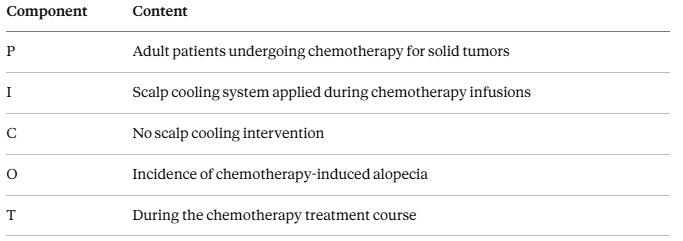
PICOT question: In adults undergoing chemotherapy for solid tumors (P), does scalp cooling during infusions (I), compared to no cooling (C), reduce the incidence of chemotherapy-induced alopecia (O) during the treatment course (T)?
How PICOT Connects to Evidence-Based Practice
The PICOT question is Step 1 of the five-step EBP process, specifically the Ask step. Without a well-formed question, the remaining steps (Acquire, Appraise, Apply, and Assess) are harder to execute because you have not defined what you are looking for.
In nursing education, three EBP models are most commonly taught.
The Iowa Model of Evidence-Based Practice (Iowa Model Collaborative, 2017, Worldviews on Evidence-Based Nursing) begins by identifying a clinical trigger, specifically a problem or knowledge gap, and uses that trigger to formulate the question that guides the search.
The Johns Hopkins Nursing EBP Model (Newhouse and colleagues, 2007, Sigma Theta Tau International) uses a PET process: Practice question, Evidence, Translation. The PICOT question is the Practice question stage.
The ACE Star Model of Knowledge Transformation (Stevens, 2004, University of Texas Health Science Center San Antonio) places the clinical question at the Discovery stage, where research knowledge is generated and defined.
All three models place question formulation at the foundation. A poorly framed question produces an unfocused search, which means you retrieve studies that do not answer your clinical question and miss the studies that do.
How to Search Databases Using Your PICOT Question
Once your PICOT question is formed, translate each component into search terms and combine them using Boolean operators.
Step 1: Identify Search Terms for Each Component
For the P, I, C, and O components, list two to four synonyms or related terms. The T component is usually applied as a date filter rather than a search term.
Example using PICOT question 12 (HbA1c and diabetes self-management):
P: type 2 diabetes, T2DM, non-insulin-dependent diabetes
I: self-management education, diabetes education program, structured patient education
C: usual care, standard care, routine counselling
O: HbA1c, glycated hemoglobin, glycemic control
Step 2: Use Boolean Operators and MeSH Terms
Combine synonyms within a component using OR. Combine components using AND. Use truncation (diabet*) to capture plural and variant spellings. In PubMed, use MeSH (Medical Subject Headings) terms alongside keyword searches. In CINAHL, use CINAHL Subject Headings.
Example search string for PubMed: ("type 2 diabetes"[MeSH] OR "T2DM") AND ("self-management education" OR "diabetes education") AND ("HbA1c" OR "glycated hemoglobin" OR "glycemic control")
Step 3: Select the Right Databases
Table 3: Recommended Nursing Databases by Research Question Type
Database | Best For | Coverage |
|---|---|---|
CINAHL (EBSCO) | Nursing-specific research | Nursing, allied health, biomedicine |
PubMed/MEDLINE | Clinical medicine and nursing research | Biomedical and life sciences |
Cochrane Library | Systematic reviews and RCTs | Cochrane Reviews, CENTRAL trial register |
PsycINFO | Mental health and behavioral nursing | Psychology, psychiatry, behavioral science |
EMBASE | Pharmacology and European research | Biomedical, pharmacological |
For most BSN-level PICOT questions, CINAHL Plus PubMed covers the majority of relevant nursing literature. For systematic reviews and EBP capstones, adding the Cochrane Library and PsycINFO is recommended. Once you have retrieved your studies, you will need to evaluate each one and document it correctly in your bibliography, a process covered fully in our guide on writing a nursing annotated bibliography for EBP.
Common PICOT Mistakes Nursing Students Make
Writing a Background Question Instead of a Foreground Question
Background questions ask general knowledge questions: "What causes pressure injuries?" Foreground PICOT questions focus on specific interventions, outcomes, or comparisons within a defined population. Your PICOT question should always be a foreground question.
Population That Is Too Broad
"All patients" or "adult patients" gives you no direction for your search. Every component of P should be clinically meaningful: age group, diagnosis, care setting, and acuity level, where relevant.
Intervention That Is Not Searchable
"Better nursing care" is not an intervention. "2-hourly repositioning with a foam wedge" is. Your intervention must be specific enough that someone could search for it in a database and retrieve studies that test it.
Outcome That Is Not Measurable
"Improved patient wellbeing" is not a searchable outcome. "Patient-reported quality of life measured by the SF-36" is. Use validated measurement tools wherever possible.
Forcing a Comparison Where None Exists
Not every PICOT question needs a C. If you are asking about the experience of a phenomenon, the prevalence of a problem, or a prognosis, there may be no meaningful comparison. In those cases, use PICO and leave out C, or use SPIDER if the question is qualitative.
Confusing the PICOT Question With the Research Question
A broader research question is: "Does self-management education improve diabetes outcomes?" A PICOT question is precise: "In adults with type 2 diabetes in outpatient primary care, does structured nurse-led self-management education compared to usual care lower HbA1c by at least 0.5% over 6 months?" The PICOT question defines the exact search.
Before you include any source retrieved from your PICOT search, confirm it meets your program's evidence standards. Our guide on how to tell if a source is peer-reviewed covers five reliable methods you can apply in any database.
PICOT in Different Nursing Education Systems
The PICOT framework is taught across nursing education systems globally, though the specific language and application vary.
United States: PICOT is central to BSN and MSN capstone and EBP competencies. The AACN Essentials (2021) embed EBP as a core competency across all 10 domains of professional nursing education, and explicitly identify formulating a searchable clinical question as a competency.
United Kingdom: The NMC Standards of Proficiency for Registered Nurses (2018) require that registered nurses demonstrate the ability to assess evidence and apply it to practice. UK programs often teach PICO or PICOT alongside SPIDER, with greater emphasis on qualitative question formulation because UK nursing research has a strong qualitative tradition.
Australia: The NMBA Registered Nurse Standards for Practice (2016) require nurses to generate and apply evidence-based, ethical, professional, and diverse perspectives to practice. Australian BSN programs at universities, including the University of Sydney, the University of Queensland, and Monash University, incorporate PICOT across EBP and research units.
Saudi Arabia and UAE: PICOT is taught in nursing programs aligned with international accreditation standards. Saudi programs accredited by the Saudi Commission for Health Specialties (SCFHS) and UAE programs accredited by the Commission for Academic Accreditation (CAA) incorporate EBP frameworks, including PICOT, into curricula increasingly aligned with US and UK standards.
South Africa and Nigeria: Nursing education is regulated by the South African Nursing Council (SANC) and the Nursing and Midwifery Council of Nigeria (NMCN), respectively. Research-active programs at institutions including the University of Cape Town and the University of Lagos include EBP competencies with PICO or PICOT as the foundational question-formulation tool.
Frequently Asked Questions About PICOT Questions
What is the difference between PICO and PICOT?
PICO contains four components: Population, Intervention, Comparison, and Outcome. PICOT adds T for Time, which specifies the duration over which the outcome is measured. Use PICO when the time frame is not clinically relevant or variable. Use PICOT when the intervention has a defined duration or the outcome is time-sensitive.
Does every PICOT question need a comparison?
No. If there is no clinically meaningful alternative to compare against, omit the C and use PICO. Some foreground questions, particularly about prognosis, prevalence, or diagnosis, have no intervention or comparison and require a different framework altogether.
What is the SPIDER framework and when should I use it?
SPIDER stands for Sample, Phenomenon of Interest, Design, Evaluation, and Research type. It was developed by Cooke, Smith, and Booth in 2012 specifically for qualitative and mixed-methods questions where the PICO structure does not fit. Use SPIDER when your question is about experiences, perceptions, or meaning rather than the effect of an intervention.
How specific does my population need to be?
Specific enough that a database search retrieves studies that apply to your patients and excludes those that do not. A population defined as "adults with type 2 diabetes in outpatient primary care aged 40 to 70" is more useful than "diabetic patients."
Can my PICOT question change after I start searching?
Yes, and this is normal. As you search the literature, you may find that the evidence is stronger for a slightly different intervention or that the population needs refinement. If you are writing a formal EBP paper or capstone, document the original PICOT question and note any revisions with the rationale, as this demonstrates methodological transparency.
How is a PICOT question used in a nursing capstone project?
The PICOT question is the foundation of the capstone. It defines the clinical problem, drives the literature search, establishes the inclusion and exclusion criteria for the studies you review, and determines the outcome you will use to evaluate the evidence. Everything in the capstone, including the search methodology, the evidence synthesis, and the clinical recommendations, flows from the PICOT question. If you have your PICOT question ready and need guidance on what comes next, our guide on how to structure a capstone project report covers every chapter.
Is PICOT used outside nursing?
Yes. PICOT originated in evidence-based medicine and is used across clinical disciplines, including medicine, pharmacy, physiotherapy, and occupational therapy. Its use in nursing was formalized through the EBP movement of the 1990s and 2000s and is now embedded in nursing education standards globally.
A PICOT Question Checklist Before You Submit
Before including your PICOT question in an assignment or EBP paper, check it against this list:
P is specific enough to retrieve relevant studies and exclude irrelevant ones
I is defined precisely and is searchable in a database
C is clinically meaningful, or is deliberately omitted with a reason
O is measurable using a validated tool or metric
T is included only where clinically relevant
The assembled question follows the standard template
The question is a foreground question, not a background question
Each component can be translated into search terms for CINAHL or PubMed
A PICOT Question That Drives the Right Search
Use the template, work through each component carefully, and test your question before you search. The 15 examples in this guide cover the range of clinical scenarios you are most likely to encounter in nursing school and capstone projects. If your scenario is different, the same process applies: start with the clinical problem, build each component with precision, and assemble the question before you open a database.
A PICOT question that uses the correct format but applies the wrong framework for the clinical question type, or that is specific enough to look correct but retrieves the wrong body of evidence, sets up an EBP paper or capstone literature search that takes twice as long and produces half the relevant studies. ScribeLab Writer's nursing writing service works with BSN and MSN students across the US, UK, Australia, UAE, and internationally to formulate PICOT questions, build CINAHL and PubMed search strategies, and develop the full EBP paper or capstone project that follows. Place your order and a member of the team will contact you within 24 hours.