

A capstone project report is one of the most misunderstood assignments in higher education. Students who have spent years writing research papers, dissertations, and literature reviews often approach a capstone the same way, and that is usually where the problems start.
A capstone is not a dissertation. It is not a research paper. It is a distinct type of academic work with its own structure, its own grading criteria, and its own rules for what counts as a strong submission. Getting that structure wrong, even when the underlying analysis is solid, costs marks at every level.
This guide covers the correct structure for a capstone project report at undergraduate and Master's level, how different disciplines approach it, what each major citation style requires, and the most common structural mistakes students make.
What Is a Capstone Project Report?
A capstone project is a culminating academic assignment that asks you to apply the knowledge, skills, and frameworks developed across your program to a real-world problem, question, or challenge in your field. The word capstone comes from the stone placed at the top of an arch: it is the piece that holds everything together.
The key distinction from a dissertation or thesis is purpose. A dissertation generates original knowledge through original research. A capstone applies existing knowledge to a practical problem and produces recommendations or a deliverable. Writing in The Michigan Daily, student Rushabh Shah put it clearly: "The holistic nature of a capstone project also tests if a student has truly internalized the values and teachings of their field."
The UK Quality Assurance Agency for Higher Education uses the term "synoptic assessment" in its Quality Code to describe this kind of work, defining it as "assessment through a task that requires students to draw on different elements of their learning and show their accumulated knowledge and breadth and depth of understanding." In the 2023 Business and Management Master's Subject Benchmark Statement, the QAA explicitly describes the capstone project as "a characteristic of the taught master's course," noting that it might take the form of a dissertation, a consultancy project, a white paper, or a business project.
Understanding this distinction before you write is essential. If you approach a capstone as if it were a thesis, you will over-theorize, under-recommend, and miss the marking criteria entirely.
How a Capstone Differs From a Dissertation, Thesis, and Research Paper
Before mapping the structure, it helps to see where the capstone sits relative to other academic writing you may have done.
TABLE 1 — Used in section: "How a Capstone Differs From a Dissertation, Thesis, and Research Paper"
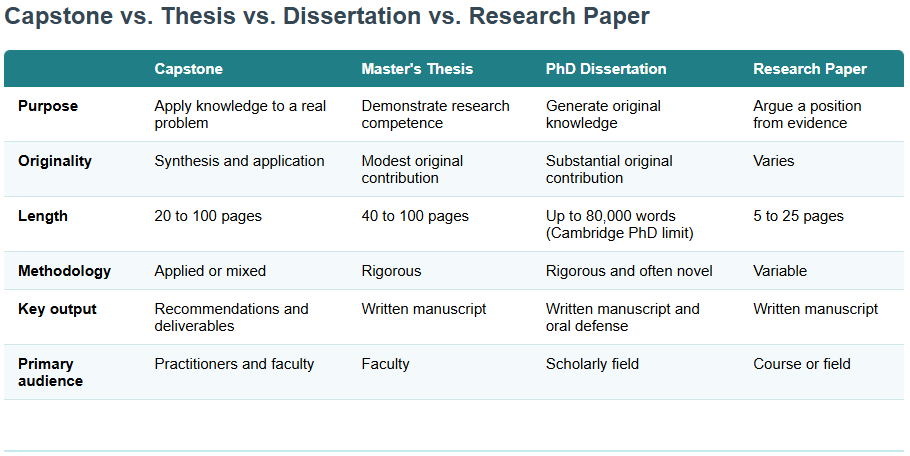
The University of Michigan's School for Environment and Sustainability makes the trade-off explicit for students choosing between the two: "Master's project work spans roughly 15 months and thesis work is done throughout the entire program." If you are heading toward industry or professional practice, a capstone is generally the more appropriate choice. If you are heading toward a PhD or an academic career, a thesis is stronger. If your program requires a research proposal before your capstone begins, our guide on how to write a strong research proposal covers the correct structure, word counts, and formatting requirements at every level.
The Standard Capstone Project Report Structure
Across universities in the US, UK, and Australia, the consensus structure for a capstone project report is consistent. Disciplines adapt it at the edges, but the core sequence holds.
Section 1 — Title Page
Your title page should include the project title, your full name, the name of your program, your institution, your supervisor or advisor's name, and the submission date. The title should be specific enough to convey the problem and context. "A Strategic Analysis of Staff Retention in NHS Mental Health Trusts" tells the reader much more than "Capstone Project."
Section 2 — Executive Summary
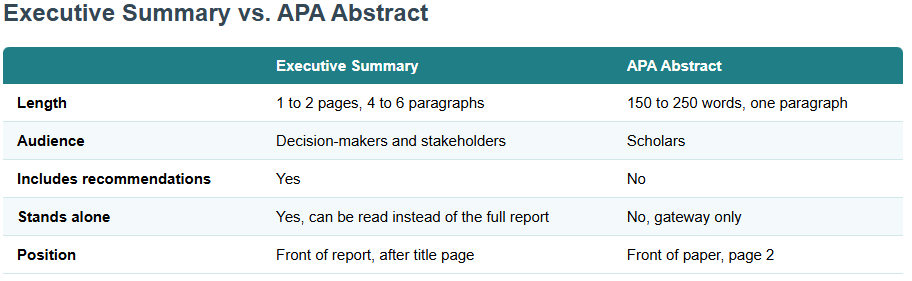
This is the most misunderstood section in the entire report. It is not an introduction. It is not an abstract. It is a standalone document that summarizes the problem, your approach, your key findings, and your recommendations in enough detail that a decision-maker could act on it without reading the rest of the report.
National University's MBA Capstone Handbook is direct on this point: "It is not an introduction to the plan, as you may have written in typical papers. This Executive Summary, although positioned first in the project, should actually be written last."
Write the executive summary after everything else is complete. It should be one to two pages, four to six paragraphs, and oriented toward a practitioner or decision-maker audience rather than an academic one. It must include your recommendations, even briefly. This is the single most common structural mistake in capstone reports: students write an executive summary that describes what the report will cover rather than what it found and recommends.
The key differences between an executive summary and an APA abstract are worth understanding:
TABLE 2 — Used in section: "Section 2 — Executive Summary"
Section 3 — Table of Contents
Include a table of contents with page numbers for all major sections and subsections. This is standard in capstone reports and expected at the master's level.
Section 4 — Introduction and Problem Statement
This section establishes the context and scope of your project. It answers three questions: What is the problem or challenge you are addressing? Why does it matter, and to whom? What is the scope of your analysis? Keep this section focused. You are not writing a broad background essay. You are framing a specific problem that your capstone will address.
Section 5 — Literature Review or Background
The literature review in a capstone is typically shorter and more applied than in a dissertation. Rather than mapping every debate in the field, your goal is to establish the theoretical and practical frameworks relevant to your problem, show that you understand the existing evidence, and identify the gap or challenge your project addresses.
Practitioner literature, industry reports, and policy documents are often more relevant here than peer-reviewed journal articles, depending on your discipline. In a business capstone, a McKinsey Global Institute report or a government economic strategy document may be more directly applicable than a journal article from 2008.
Keep this section focused. Overlong literature reviews are one of the most common structural problems in capstone reports, because students default to dissertation habits. For a detailed look at where students most commonly go wrong when treating applied projects like theoretical ones, our guide on 10 common dissertation mistakes students make covers the patterns that carry over from dissertations into capstone work.
Section 6 — Methodology
Your methodology section explains how you gathered and analyzed the information that underpins your findings and recommendations. This might involve primary research (interviews, surveys, observations), secondary research (document analysis, literature synthesis), case study analysis, financial modeling, or a combination.
The key requirement at every level is justification. Do not simply describe what you did. Explain why you chose this approach and why it is appropriate for your specific problem. A common mistake is presenting methodology without justification, which signals to markers that the method was chosen without critical reflection.
For nursing and health capstones, the PICO framework (Patient/Population, Intervention, Comparison, Outcome) provides a structured methodology appropriate to evidence-based practice projects. For business capstones, frameworks such as SWOT, PESTLE, or Porter's Five Forces often underpin the analytical methodology.
Section 7 — Findings, Results, and Analysis
This is typically the longest section of the report. It presents what you discovered and what it means. In quantitative capstones, this includes data tables, statistical results, and their interpretation. Qualitative capstones include thematic analysis, case findings, or stakeholder perspectives. In policy or business capstones, it might include financial projections, risk assessments, or strategic analysis.
Present your findings in a logical order that builds toward your recommendations. Group related findings together. Use headings and subheadings to help the reader navigate. Tables, figures, and charts are appropriate and expected at this stage.
H3: Section 8 — Discussion and Strategic Implications
This section draws the findings together and explains what they mean in the context of your research question and the broader field. How do your findings compare to the existing literature? What are the implications for practice, policy, or strategy? Are there tensions or contradictions in your data that need to be addressed?
This is where critical thinking is most visible. A strong discussion does not simply restate the findings. It interprets them.
Section 9 — Recommendations and Implementation Plan
This is the defining section of a capstone report. It is what separates a capstone from a dissertation. Where a dissertation contributes to theoretical knowledge, a capstone produces actionable recommendations for a real audience.
Your recommendations should be specific, practical, and tied directly to your findings. Vague recommendations such as "the organization should improve communication" are not sufficient. Strong recommendations specify what should be done, by whom, within what timeframe, and at what cost or resource implication.
Many capstones, particularly at the business and policy level, also require an implementation plan: a sequenced set of steps for putting the recommendations into practice. Harvard Kennedy School's Master in Public Policy capstone, which runs to approximately 40 pages or 10,000 words, places the policy recommendations and implementation roadmap at its center.
This section is often the weakest in submitted capstone reports. Students spend the most time on the literature review and findings, then rush the recommendations. Prioritize this section. It is the one your assessors will look at first and weigh most heavily.
Section 10 — Conclusion
The conclusion is short: typically one to two pages. It summarizes the problem you addressed, restates your key findings and recommendations in a paragraph, acknowledges the limitations of your analysis, and identifies areas for future research or action. It does not introduce new arguments or findings.
Section 11 — References
Your complete reference list, formatted in your required citation style. References are typically excluded from the word count, but confirm this with your program.
Section 12 — Appendices
Supporting material that is relevant to the report but too detailed or lengthy to include in the body. This might include survey instruments, interview transcripts, data tables, financial models, organizational charts, or additional case documentation. Label each appendix clearly (Appendix A, Appendix B) and reference each one in the body of the report.
How Long Should a Capstone Project Report Be?
Length expectations vary significantly by level and discipline.
Undergraduate capstones: Typically 20 to 40 pages. Some professional programs, such as AACRAO's Student Enrollment Management capstone, cap submissions at 8 to 10 pages, including tables.
Master's capstones: 30 to 60 pages is the typical range. Harvard Kennedy School's Master's in Public Policy capstone runs to approximately 40 pages or 10,000 words. CUNY's MA in Digital Humanities prescribes a 20 to 25-page white paper alongside a digital artifact.
DNP (Doctor of Nursing Practice) capstones: 40 to 100 or more pages. Substantially longer than coursework but shorter than a PhD dissertation.
Nursing BSN and MSN capstones: 20 to 100 pages, depending on the program, typically structured around the PICO framework and evidence-based practice synthesis.
Always confirm the expected length with your program handbook before writing. These figures represent typical ranges, not universal requirements.
How Citation Style Applies to Capstone Reports
Your citation style governs the formatting of your document, your in-text references, and your reference list. It does not prescribe the capstone structure. That comes from your institution. Here is what each major style requires for capstone-level work.
APA 7th Edition
APA 7 is the default for nursing, education, business, public health, social sciences, and the majority of US capstone programs. DNP capstones almost universally require APA 7.
For a capstone, use the student paper format: title page with paper title, author name, affiliation, course, instructor, and date, all double-spaced. 1-inch margins. Double-spaced throughout. Accepted fonts include Times New Roman 12pt, Calibri 11pt, Arial 11pt, and Georgia 11pt.
Note that a capstone may include both an APA abstract (150 to 250 words, no recommendations, one paragraph) and an executive summary (1 to 2 pages, includes recommendations, stands alone). These are distinct documents serving different purposes. Many capstone programs require both.
Use APA Level 1 headings for all major sections: Introduction, Literature Review, Methodology, Findings, Recommendations, Conclusion. Use Level 2 headings for subsections within each.
For grey literature, government reports, and organizational documents, which are common in applied capstone work, use APA's report and webpage entry formats in your reference list.
MLA 9th Edition
MLA 9 is rarely required for capstone reports outside humanities disciplines such as literature, cultural studies, or creative writing. If your program requires it, use the standard MLA first-page heading (Name, Instructor, Course, Date) rather than a separate title page unless instructed otherwise. Works Cited replaces the References page. Running head with surname and page number in the upper-right of every page.
Harvard Referencing
Harvard is common in UK and Australian capstone programs, particularly in business and management. As with all Harvard use, confirm your institution's specific variant before writing your reference list. The four most common are Cite Them Right Harvard, Manchester Harvard, SAGE Harvard, and Anglia Ruskin Harvard. Each differs in punctuation and capitalization rules.
In-text citation format follows the author-date system: (Smith, 2021) for a single author, (Smith and Jones, 2021) for two authors, (Smith et al., 2021) for three or more. Reference list entries are alphabetical by author surname with the year in parentheses after the name.
The Chicago 17th Edition (Turabian 9th)
Chicago style is used for capstones in history, theology, art, and some policy programs. Use the Notes and Bibliography system for humanities-leaning capstones, and the Author-Date system for policy and social science capstones. Turabian 9th edition is the student-facing version of Chicago 17 and is the appropriate reference for most students.
Title page format: title centered one-third down the page, author name and program details several lines below. 1-inch margins. 12pt Times New Roman. 0.5-inch paragraph indent. Double-spaced throughout.
Note: The University of Chicago Press released CMOS 18 in September 2024. Many academic libraries and departments still recommend CMOS 17 while citation databases update. Confirm with your department which edition is current before you begin.
How Discipline Affects Capstone Structure
The core structure above applies across disciplines, but the emphasis and format of individual sections vary.
Business and MBA Capstones
Business capstones typically follow a modified structure that adds company or industry identification, market analysis, and financial modeling. The executive summary is critical and usually the most weighted section. Harvard and APA are the most common citation styles. Average length: 30 to 60 pages.
Nursing and DNP Capstones
Nursing capstones are structured around the PICO framework and evidence-based practice. The Johns Hopkins School of Nursing describes its DNP project as establishing "each graduate as a Hopkins Nursing clinical scholar." APA 7 is mandatory. Quality improvement frameworks such as Plan-Do-Study-Act often structure the methodology section. Length: 40 to 100 pages for DNP capstones; 20 to 60 pages for BSN and MSN.
Education Capstones
Education capstones typically use an action-research format, with a classroom-based intervention or program evaluation at the center. APA 7 is standard. Reflective practice sections are often included. Length: typically 30 to 50 pages.
Engineering and STEM Capstones
STEM capstones often combine a physical prototype, software system, or technical deliverable with a written report in ACM or IEEE conference paper format. Rutgers ECE's capstone guidelines prescribe sections including design constraints, standards compliance, ethics, and sustainability. Length: 8 to 25 pages for the written component, depending on the program.
Social Sciences Capstones
Social science capstones sit closest to mini-theses. They are research-question driven, use rigorous methodology, and follow APA 7 or the Chicago Author-Date style. Length: 30 to 60 pages.
The Most Common Structural Mistakes in Capstone Reports
These are the errors assessors see most frequently, and they are all avoidable.
Treating the capstone as a dissertation. Generating a new theory when the task asks for applied analysis. Overloading the literature review at the expense of findings and recommendations.
An executive summary that describes instead of recommending. Writing what the report will cover rather than what it found and recommends. This misses the purpose of the section entirely.
Weak or vague recommendations. "The organization should improve its processes" is not a recommendation. A recommendation specifies what should be done, by whom, by when, and how.
Methodology without justification. Describing your method without explaining why it was the appropriate choice for your specific problem.
Inconsistent citation style. Mixing Harvard in-text citations with an APA reference list, or using footnotes in an APA paper. This signals insufficient proofreading.
Missing the executive summary entirely. Some students skip it or confuse it with the introduction. It is a required, graded section.
Appendices that are never referenced. Every appendix should be referred to in the body of the report with a clear label (see Appendix A).
Failing to align with the program rubric. Capstones are typically graded against a specific rubric that your program provides. Read it before you write, not after.
A Quick Note on AI Disclosure in Capstone Reports
As of 2026, most UK and US universities require disclosure of AI tool use in assessed work. If you used AI tools in any part of your capstone, including research, drafting, or editing, disclose this according to your institution's current policy. Cambridge requires explicit acknowledgment in assessed work. APA 7 provides specific citation guidance for AI-generated content.
Ready to Write?
The structure of a capstone project report follows a clear logic: you establish a problem, review what is known, explain how you investigated it, present what you found, and make specific recommendations for action. The executive summary frames all of that for the decision-makers who matter most to your project.
If you are working on a capstone project and need support with structure, argument development, or formatting, ScribeLab Writer works with undergraduate and Master's students across all disciplines, including business, nursing, education, and social sciences. Visit scribelabwriter.com to get a quote.