

The nursing literature review is the chapter that separates acceptable projects from excellent ones. It is not a summary of what you read. It is a systematic, critical analysis of what the evidence collectively shows about your clinical question, and it is the foundation on which every argument in your dissertation, capstone, or DNP project rests. When a committee questions your methodology, your recommendations, or your conclusions, every answer comes back to the literature review.
The challenge is that nursing programs teach students to find and cite sources long before they teach them to synthesize evidence. Students arrive at the literature review chapter knowing how to write a paragraph about a study; they do not always know how to write a chapter that makes studies speak to each other. This guide covers the full process from the first database search to the final thematic section, with specific guidance for US capstone and DNP projects as well as international dissertation programs. For BSN, MSN, and DNP students who need support turning multiple appraised studies into a coherent thematic chapter, ScribeLab Writer's nursing writing service covers every stage of this process for students across the US, UK, Australia, and internationally.
Quick Answer:
A nursing literature review systematically searches, appraises, and synthesizes existing evidence on a clinical question. The process has six stages: define the research question using PICOT or SPIDER; build a documented search strategy across databases including CINAHL Complete and PubMed; apply inclusion and exclusion criteria to screen retrieved sources; critically appraise each source using a validated tool such as the CASP checklists; organize the appraised evidence in a synthesis matrix; and write thematically, synthesizing what multiple sources collectively show rather than summarizing sources individually. For DNP projects and capstone assignments, the literature review must demonstrate that you have appraised the evidence base and identified a practice gap that your project addresses.
What Is a Nursing Literature Review?
A literature review is a critical analysis and synthesis of existing published research on a defined topic or clinical question. In nursing, the most widely used definition comes from the nursing research literature: it is a written summary and critical analysis of relevant literature that is conducted to identify what is currently known about a topic or issue of interest (Flanagan & Beck, 2025; LoBiondo-Wood & Haber, 2025).
This definition has two components that students often separate when they should hold together. A literature review is both a process and a product. The process involves systematic searching, rigorous appraisal, and careful synthesis. The product is a written chapter that presents the state of knowledge on a topic in a way that justifies your research question, clinical question, or practice change.
The distinction matters because a review that produces a well-written chapter without a rigorous process behind it is not a literature review. It is an essay. Committees, reviewers, and faculty can tell the difference, and the difference is graded.
Dissertation, Capstone, DNP Project, and Thesis: US vs. International Terminology
Before writing a single search term, you need to be clear about the type of scholarly work you are producing, because the terminology differs significantly between the US and international systems, and your program may use different terms than the ones you find in most literature review guides.
In the United States:
BSN capstone: A culminating undergraduate project that applies course learning to a clinical problem. Often requires a focused literature review of five to ten peer-reviewed sources.
MSN thesis: A graduate-level research manuscript. Requires a comprehensive literature review with a documented search strategy, formal appraisal, and synthesis.
DNP scholarly project (or DNP capstone): The terminal project for the Doctor of Nursing Practice degree. Not original research: rather, a practice improvement initiative grounded in evidence synthesis. The AACN (2021) specifies that DNP projects must demonstrate "synthesis of the evidence" and apply that synthesis to practice change. The literature review is a required chapter demonstrating this synthesis.
PhD dissertation: Original research generating new knowledge. Requires a comprehensive literature review establishing the gap that the dissertation research addresses.
In the United Kingdom, Australia, and internationally:
A dissertation is used broadly for both undergraduate and postgraduate research projects. MSc and PhD dissertations both include literature reviews, with the PhD review being substantially more comprehensive.
A thesis is used for PhD-level work in the UK, though usage varies.
If your program uses the term "capstone" or "DNP project," the literature review guidance in this article applies directly. If you are writing a UK MSc dissertation, the process is identical: only the terminology differs.
Four Types of Literature Review and When to Use Each
Not all literature reviews are the same, and the type you choose shapes every methodological decision that follows. The most important distinction is between a systematic review and a narrative review, but integrative and scoping reviews are increasingly common in nursing capstones and DNP projects.
Table 1: Types of Literature Review in Nursing
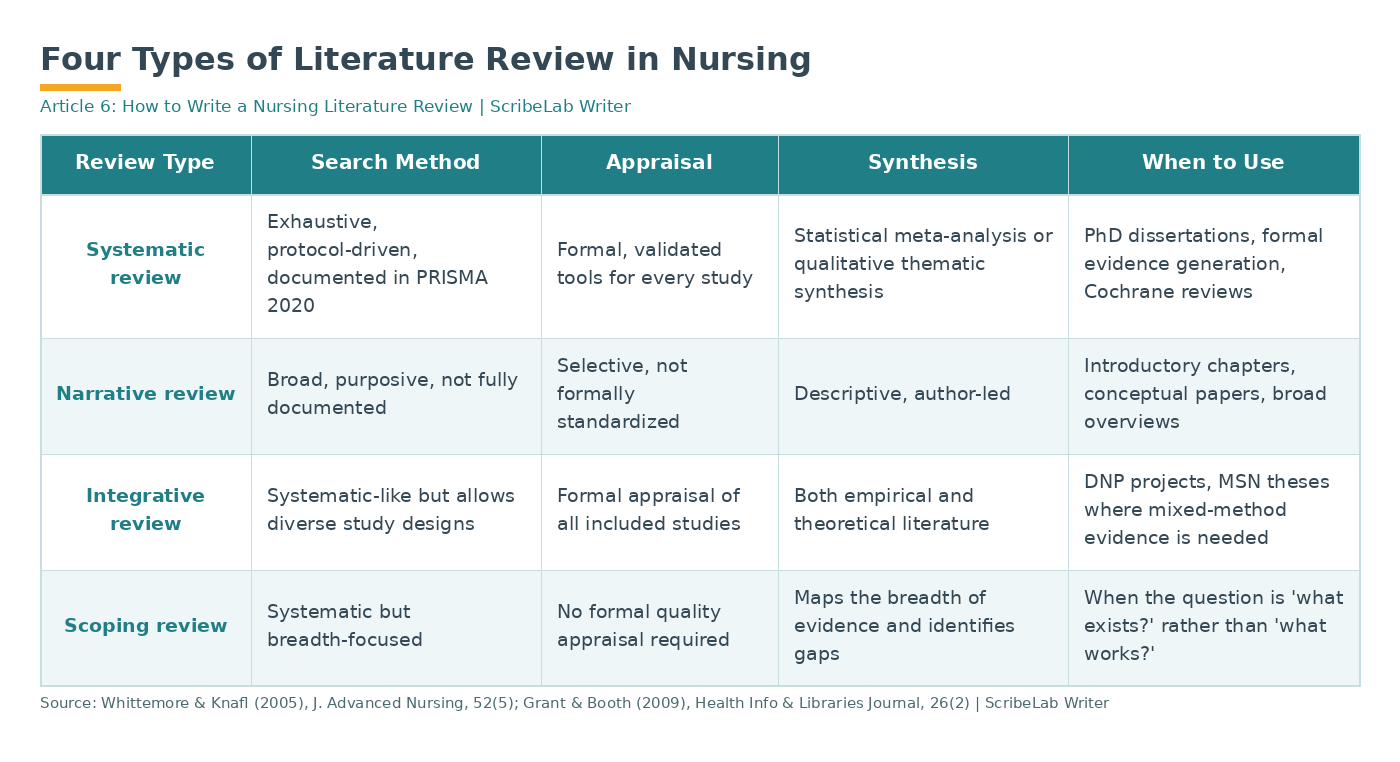
The integrative review, described by Whittemore and Knafl (2005) in the Journal of Advanced Nursing, is the most flexible and is particularly appropriate for nursing capstones and DNP projects because it allows you to combine quantitative and qualitative evidence, empirical studies, and theoretical papers in a single review. This is important because clinical nursing questions often require both quantitative evidence about effectiveness and qualitative evidence about patient experience.
For most BSN capstones and MSN theses, a structured narrative review with a documented search strategy and critical appraisal is the expected and appropriate format. For DNP projects that require evidence synthesis to drive a practice change initiative, an integrative review is often most appropriate.
Step 1: Define Your Research Question Using PICOT or SPIDER
The literature review begins with a question, not a topic. A topic is "fall prevention in elderly patients." A question is "In adults aged 65 and over admitted to inpatient units, does a structured nurse-led hourly rounding protocol compared to standard call-bell response reduce the rate of inpatient falls during hospitalization?"
The question format determines what evidence you include and what you exclude. Without a focused question, your search returns thousands of results, and your review becomes a loose collection of tangentially related studies rather than a disciplined appraisal of what the evidence shows on a specific clinical issue.
For intervention questions (does this nursing action improve this outcome?), use the PICOT framework: Patient/Population, Intervention, Comparison, Outcome, Time. A complete guide to formulating a PICOT question with 15 clinical examples is available for reference.
For qualitative or experience-focused questions (what is the lived experience of this population? what are the barriers to this nursing practice?), use the SPIDER framework: Sample, Phenomenon of Interest, Design, Evaluation, Research type (Cooke, Smith, & Booth, 2012). SPIDER is particularly useful for reviews that include phenomenological and grounded theory studies.
Write the question out in full and have your supervisor or faculty confirm it before you search. A strong search cannot rescue a weak or unfocused question.
Step 2: Build Your Search Strategy
A search strategy is not a Google search. It is a documented, reproducible plan that specifies exactly where you searched, what terms you used, how you combined them, and what limits you applied. It must be reproducible: meaning another researcher should be able to follow your described strategy and arrive at the same pool of results.
Choose the Right Databases
For nursing literature reviews, the primary databases are:
CINAHL Complete (Cumulative Index to Nursing and Allied Health Literature): The most comprehensive nursing-specific database, indexing more than 5,000 nursing and allied health journals maintained by EBSCO Information Services. For any nursing clinical question, this is the first database to search.
PubMed/MEDLINE: Maintained by the National Library of Medicine, PubMed provides access to over 37 million biomedical and life science citations. For clinical, pharmacological, or physiological questions that extend beyond nursing-specific literature, PubMed is essential.
Cochrane Library: Houses Cochrane Systematic Reviews and the CENTRAL register of clinical trials. If a Cochrane review exists for your PICOT question, it represents Level I evidence and should be included.
PsycINFO: The primary database for mental health, psychiatric nursing, behavioral science, and psychological dimensions of nursing care. For any review addressing mental health, patient experience, or psychosocial outcomes, add PsycINFO.
EMBASE: Particularly strong for pharmacological research and European clinical literature. Add this database for pharmacology, drug therapy, or reviews requiring European perspectives.
For guidance on confirming whether a retrieved source qualifies as peer-reviewed before including it in your appraisal, see the guide on identifying peer-reviewed sources.
Build Your Search String
For each component of your PICOT question, identify two to four synonyms or related terms. Combine synonyms within a component using OR. Connect components using AND.
Example using the fall prevention PICOT question above:
P: "elderly patients" OR "older adults" OR "adults aged 65" OR "geriatric patients"
I: "hourly rounding" OR "intentional rounding" OR "nursing rounds"
C: "standard care" OR "usual care" OR "call bell"
O: "patient falls" OR "fall rate" OR "fall prevention" OR "fall incidence"
Combined string: ("elderly patients" OR "older adults" OR "adults aged 65") AND ("hourly rounding" OR "intentional rounding") AND ("patient falls" OR "fall rate" OR "fall prevention")
Use database-specific controlled vocabulary where available: MeSH (Medical Subject Headings) in PubMed, and CINAHL Subject Headings in CINAHL. These controlled terms capture relevant studies that may use different keywords.
Set Inclusion and Exclusion Criteria
State your criteria before you begin screening, not after seeing the results. Common criteria for nursing literature reviews:
Table 2: Inclusion and Exclusion Criteria
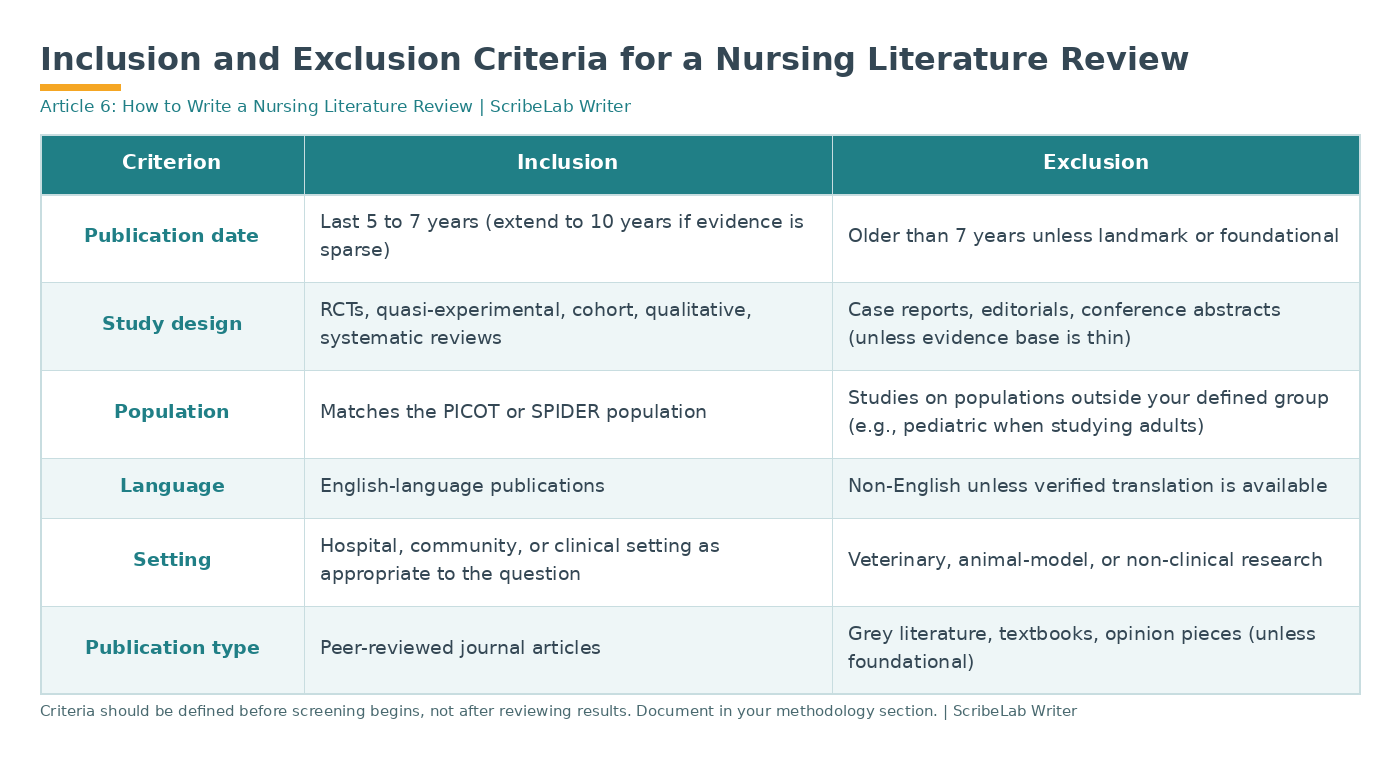
Document these criteria in your methodology section. They are the basis on which reviewers will judge whether your included evidence is appropriate.
Step 3: Screen and Select Sources
After running your searches across databases, you will have a pool of results that may run to several hundred records. Screening happens in two stages.
Stage 1: Title and abstract screening: Review the title and abstract of each record against your inclusion/exclusion criteria. Remove duplicates first. Exclude records that clearly do not meet criteria based on title and abstract alone. Record how many you excluded and why.
Stage 2: Full-text review: Retrieve the full text of all records that passed Stage 1. Review each against the inclusion criteria at the full-text level. Some studies will be excluded at this stage because the full text reveals they do not match the population, intervention, or outcome despite an appropriate-sounding abstract.
Document the numbers at each stage: total records identified, records screened, full texts assessed, and final studies included. For systematic and integrative reviews, this screening process is typically depicted in a PRISMA 2020 flow diagram (Page et al., 2021). The PRISMA 2020 statement was published in the BMJ (Page et al., 2021, 372, n71; DOI: 10.1136/bmj.n71) and is the current reporting standard for systematic search-based reviews.
Even for narrative reviews at the BSN level, documenting your screening process builds transparency and demonstrates research rigor. Some faculty require a simple flow diagram; others require only a written description of the screening process. Check your guidelines.
Step 4: Critically Appraise Each Source Using CASP
Critical appraisal is the process of systematically evaluating a study for its validity, reliability, and relevance to your clinical question. It is what separates a literature review from a list of summaries.
The Critical Appraisal Skills Program (CASP), developed in the UK and freely available at casp-uk.net/casp-tools-checklists/, provides validated checklists for multiple study designs, including randomized controlled trials, systematic reviews, qualitative studies, cohort studies, and case-control studies. These checklists guide you through the key methodological questions for each study type: blinding, allocation concealment, sample adequacy, data saturation, credibility, and produce a structured appraisal that can be summarized in your evidence table.
For each included study, ask three questions:
Validity: Was the study conducted rigorously? Was the design appropriate for the question? Were biases minimized?
Reliability: Are the results consistent and reproducible? Is the sample large enough to detect a meaningful difference? Are outcomes measured using validated tools?
Applicability: Are the study's population, setting, and outcomes sufficiently similar to your clinical context to make the findings applicable?
A study can have strong internal validity but low applicability to your question. A study with a small sample may still have important findings if it is one of the only studies on a rare clinical topic. Your appraisal must capture both the quality of the evidence and its relevance to your specific PICOT question.
Record your appraisal in an evidence table: one row per study, with columns for: author(s) and year, study design, sample (n and characteristics), PICOT alignment, key findings, level of evidence, methodological strengths, limitations, and applicability rating.
Step 5: Organize Your Evidence with a Synthesis Matrix
A synthesis matrix is a table that organizes your appraised sources by theme or concept rather than by individual study. Themes run across the top row; sources are listed in the left column. Each cell records what that source contributes to that theme (Ingram et al., 2006).
The synthesis matrix is the planning tool for your writing. It makes themes visible before you write them. Instead of reading through 12 papers and trying to write a synthesis from memory, you can see at a glance which three studies address Theme A, which five studies address Theme B, which two studies contradict each other on Theme C, and which theme has the weakest evidence base.
A simple matrix for a fall prevention literature review might have columns for: definition and prevalence of inpatient falls, effectiveness of hourly rounding, effectiveness of fall risk assessment tools, barriers to fall prevention implementation, and patient perspectives on fall prevention. Each row represents one included study. Each cell is a note summarizing what that study contributes to that column's theme.
Once your matrix is complete, you can see your themes and write directly from the matrix to the page, with each thematic H2 section drawing on the relevant studies.
Building a synthesis matrix across 12+ sources and struggling to write thematically? |
|---|
Organizing appraised evidence into themes, writing synthesis paragraphs that make multiple studies speak together rather than summarizing each source individually, and identifying a defensible practice gap are the three stages where most nursing literature reviews lose marks. ScribeLab Writer's nursing writing team supports BSN, MSN, and DNP students with synthesis matrix construction, CASP appraisal, and thematic chapter writing for dissertations and capstone projects across the US, UK, Australia, and internationally. |
Step 6: Write the Literature Review
The literature review is organized thematically, not chronologically, and not by source. Do not walk through your sources one by one. Walk through the themes in your clinical question, drawing on sources to support each point.
Introduction to the Literature Review Chapter
Open with a brief overview of the clinical problem and its significance, a statement of your research or clinical question, and a description of how the review was conducted (databases, dates, inclusion criteria, number of studies included). The introduction tells the reader what the review covers and how.
Thematic Body Sections
Each major theme becomes an H2 section. Within each section, you synthesize what the evidence collectively shows: not what individual studies say. The difference is critical.
Summary (avoid): "Smith and Jones (2022) found that hourly rounding reduced falls. Williams et al. (2021) also studied hourly rounding and found a reduction. Lee (2023) conducted a systematic review and found that hourly rounding was effective."
Synthesis (use): "Across four RCTs and one systematic review, nurse-led hourly rounding consistently reduced inpatient fall rates by 15 to 32 percent compared to standard call-bell care (Smith & Jones, 2022; Williams et al., 2021; Lee, 2023). The reduction was statistically significant in three of the four RCTs (p < .05), though effect sizes varied with implementation fidelity: units where rounding was documented and monitored showed the largest reductions. In contrast, units relying on self-reported compliance showed more modest results."
In the synthesis version, the studies speak together. The reader learns what the collective evidence shows, where it is consistent, where it varies, and what the variation tells us. That is the work the literature review is supposed to do.
Move logically from theme to theme. Where evidence is strong and consistent, say so. Where evidence is mixed, conflicting, or limited, say that too. A literature review that presents only positive findings is not a rigorous review: it is a selective presentation.
Identifying and Articulating the Gap
Every literature review should move toward identifying the gap: the clinical question, clinical population, intervention variant, or context that the existing evidence does not yet address. The gap is what justifies your project.
Do not announce the gap as though it is a personal opinion. Derive it from the evidence: "While the evidence strongly supports hourly rounding as a fall prevention strategy, no studies in the reviewed literature examined implementation in post-acute rehabilitation settings, where patient mobility profiles and nursing ratios differ substantially from the acute care contexts studied." That gap, derived from the evidence, is the justification for your DNP project, capstone, or MSN thesis.
Conclusion of the Literature Review Chapter
The conclusion draws together the themes, summarizes the overall state of the evidence, and states what the literature review demonstrates is known and not yet known. It does not introduce new studies or arguments. It should end with a clear statement connecting the evidence gap to the purpose of your project.
You May Also Find Useful
PRISMA 2020 and When You Need It
PRISMA 2020 (Preferred Reporting Items for Systematic Reviews and Meta-Analyses) is the reporting standard for systematic search-based reviews, published by Page and colleagues in the BMJ in 2021 (Page et al., 2021). It provides a 27-item checklist and a four-phase flow diagram (Identification, Screening, Eligibility, Included) that documents every stage of the search and screening process.
You need to follow PRISMA 2020 reporting standards if:
Your DNP project, capstone, or dissertation specifies a systematic review as the evidence synthesis method.
Your program requires documentation of the search-to-inclusion process.
You plan to publish your literature review findings in a peer-reviewed journal.
You do not need a formal PRISMA flow diagram for a standard narrative or integrative review at the BSN level, though documenting your search numbers in text form is still expected.
At the DNP and MSN level, many programs now require a PRISMA-style flow diagram even for integrative reviews. Check your faculty guidelines and your institutional handbook.
What Your DNP Project or Capstone Literature Review Must Demonstrate
The American Association of Colleges of Nursing's Essentials (2021) specify that DNP projects must demonstrate synthesis of evidence and its translation into practice. The literature review chapter is the formal demonstration of that synthesis.
Specifically, a DNP project literature review should show that you:
Identified all relevant evidence. Your search was systematic, documented, and covered the appropriate databases and date ranges. You did not rely on convenience samples of sources you already knew.
Appraised the evidence critically. You evaluated each study for validity, reliability, and applicability, not merely summarized it. You used a validated appraisal tool (CASP, Johns Hopkins EBP Appraisal Tool, or Melnyk Rapid Critical Appraisal checklists).
Synthesized across studies. Your review presents what the collective evidence shows, including where studies agree, where they conflict, and what gaps remain.
Identified the practice gap. The literature review demonstrates that a gap exists in current evidence or current practice that your DNP project addresses. The project must be grounded in this gap: not chosen independently of the evidence.
Connected the evidence to the change model. For DNP projects using the Iowa Model, Johns Hopkins, or another framework, the literature review provides the evidence base that the model's translation phase will apply to practice.
For a complete guide to writing the evidence-based practice paper that accompanies many DNP and capstone projects, the companion article covers the full seven-step EBP process and APA formatting in detail.
Common Literature Review Mistakes
Summarizing instead of synthesizing. The most common and most penalized mistake. Every paragraph in the body of your review should address a theme, not a source. If you find yourself writing "According to Smith (2022)..." at the beginning of every paragraph, you are summarizing, not synthesizing.
Not documenting the search. If you cannot tell a reader exactly where you searched, what you searched for, and how you screened results, your review is not reproducible and cannot be evaluated as rigorous. Committees will ask about your search strategy, and you must be able to answer precisely.
Using sources outside the date range without justification. Most nursing programs require sources from within the last five to seven years. If you use an older source, justify it explicitly: is it a foundational or landmark study? A methodological reference (such as Whittemore & Knafl, 2005)? State the reason in your text.
Mixing up summary and critical appraisal. Appraisal means evaluating whether the evidence is good. It does not mean accepting every finding at face value. A study with n = 15 and no control group is not strong evidence for a practice change, and your review should say so.
Presenting conflicting evidence without explanation. When studies disagree, the review must explain why. Were they different populations? Different intervention intensity? Different measurement tools? Conflicting evidence is not a problem to hide: it is information to analyze.
Ignoring qualitative evidence. Nursing practice requires understanding patient experience, barriers to care, and the meaning of health phenomena. Purely quantitative reviews often miss essential context. Include qualitative studies where they are appropriate to the question, and note their level of evidence clearly (Level V or VI in the Melnyk hierarchy).
Letting your synthesis drift from the clinical question. Every paragraph, every study, every theme should trace back to the PICOT or SPIDER question you stated at the start of the chapter. If a source does not address the question, it does not belong in the review, no matter how interesting or relevant it seems.
How Literature Reviews Are Assessed Across Nursing Education Systems
United States: DNP programs require evidence synthesis as a core competency per the AACN Essentials (2021). BSN capstones require a focused, appraised literature review of typically six to ten sources. MSN theses require a comprehensive, systematic search-based review. PhD dissertations require an exhaustive review establishing the gap for original research.
United Kingdom: MSc nursing dissertations require a full literature search with documented methodology, critical appraisal, and thematic synthesis. The NMC Standards of Proficiency for Registered Nurses (2018) embed evidence-based practice as a core proficiency. Many UK programs use CASP checklists by convention.
Australia: NMBA Standards for Practice (2016) require evidence-based care. Australian universities, including the University of Sydney, the University of Melbourne, and Monash, teach integrative and systematic review methodology at the postgraduate level. Australian nursing dissertations are assessed on search rigor, appraisal quality, and synthesis depth.
Saudi Arabia and UAE: Programs aligned with US accreditation standards (SCFHS, CAA) increasingly require literature reviews that follow US-style methodology. Many Saudi and UAE nursing students complete BSN and MSN programs using the Melnyk framework and CINAHL as the primary database, making the process described in this guide directly applicable.
Frequently Asked Questions About Nursing Literature Reviews
How many sources do I need for a nursing literature review?
It depends on the level of your program. BSN capstone: typically 6 to 12 peer-reviewed sources focused on the clinical question. MSN thesis: 15 to 30 sources with a documented search strategy. DNP scholarly project: however many sources the systematic/integrative search returns after applying your criteria, with no predetermined target: let the evidence base determine the number. PhD dissertation: comprehensive review with no fixed maximum.
What is the difference between an integrative review and a systematic review?
A systematic review uses a predefined, exhaustive protocol to answer a focused clinical question, typically involving meta-analysis. An integrative review (Whittemore & Knafl, 2005) allows a broader range of study designs: quantitative and qualitative, empirical and theoretical, and synthesizes them without necessarily pooling statistics. Integrative reviews are particularly well-suited to nursing practice questions where the evidence base includes both effectiveness research and experience research.
Can I use textbooks in a nursing literature review?
Foundational nursing research textbooks (Flanagan & Beck, 2025; LoBiondo-Wood & Haber, 2025; Melnyk & Fineout-Overholt, 2023) are appropriate for methodological definitions and frameworks. They are not appropriate as the primary evidence base for clinical claims: use peer-reviewed journal articles for those. Textbooks are cited in the methodology section when you are explaining a review type, appraisal approach, or EBP model; they are not cited in the synthesis sections as evidence that a clinical intervention works.
How recent do sources need to be?
Most programs require sources from within the last five to seven years. Exceptions include foundational methodological sources (such as Whittemore & Knafl's 2005 integrative review methodology, which remains the standard) and landmark clinical studies that established a fundamental evidence base. When you use an older source, acknowledge its age and explain why it is still appropriate: "Although published in 2005, Whittemore and Knafl's integrative review methodology remains the standard reference for this review type."
What is a synthesis matrix, and do I need one?
A synthesis matrix is a table that maps your included sources against your themes, making visible what each source contributes to each thematic area (Ingram et al., 2006). It is a planning and organizational tool, not a section of your final document. You use it to plan your thematic sections; your faculty does not typically see it unless your program requires it as an appendix. Using one makes the writing substantially faster and more coherent.
Do I need to follow PRISMA 2020 for a DNP project?
If your program specifies a systematic or integrative review and requires documentation of the search process, then yes: follow PRISMA 2020 reporting standards and include a flow diagram. If your program requires only a structured narrative review, PRISMA is not strictly required, but documenting your search numbers in the methodology section is expected at the DNP level, regardless. Always confirm with your faculty.
How do I handle conflicting evidence in the review?
Address it directly and analytically. Explain what the studies found, identify the methodological differences that might account for the conflict (sample size, population characteristics, intervention fidelity, outcome measurement tools), and conclude what the conflicting evidence collectively suggests. Conflicting evidence is a sign of a complex question: an opportunity to demonstrate analytical depth, not a problem to minimize.
Completing the Chapter That Defines Your Project
The literature review is not a formality. It is the foundation. Every clinical recommendation your project makes, every practice change you propose, and every argument you will defend in your committee presentation or viva traces back to what the evidence says in this chapter.
Build the search before you decide what you want to find. Appraise every source before you quote it. Synthesize across studies rather than reporting them individually. Identify the gap from the evidence rather than choosing the topic and then finding supporting literature. These four principles separate a literature review that passes from one that leads a project.
If you are working on a nursing dissertation chapter, capstone literature review, or DNP project evidence synthesis and need support with the database search, CASP appraisal, synthesis matrix, or thematic writing, ScribeLab Writer's nursing writing service works with BSN, MSN, and DNP students across the US, UK, Australia, UAE, and internationally.