

Most universities globally follow a broadly consistent rule: your reference list, bibliography, and appendices are excluded from the word count, while the main body of your text is included. But "broadly consistent" is not "universal," and the elements that cause the most confusion, specifically footnotes, tables, in-text citations, and abstracts, are handled differently depending on which institution you attend, which subject you are studying, and what your assignment brief specifies.
This guide covers the standard global position for each element, the verified exceptions at named institutions across the UK, Australia, and North America, and the single rule that overrides everything else. For students who need their paper formatted to their institution's exact specification before submission, ScribeLab Writer's editing and proofreading service checks word count compliance, trims over-length submissions while preserving the argument, and formats papers to institutional standards.
Quick Answer:
At the vast majority of universities globally, your reference list or bibliography does not count toward the word limit. Appendices are excluded, provided they contain supplementary material, not content essential to your argument. Text inside table cells is generally counted; table headings and column labels are not. Footnotes are the most variable element: most universities exclude citation-only footnotes, but institutions including Oxford (Language and Literature), the University of East Anglia, SOAS, and the Australian National University College of Asia and Pacific explicitly include them. In-text citations such as (Smith, 2023) are almost universally counted as part of the main body. Your assignment brief takes precedence over every general rule on this page.
The Standard Position Most Universities Follow
Before covering the exceptions, it is worth establishing the baseline that the majority of institutions apply. The University of Worcester Library FAQ (last updated January 2025) summarizes it clearly: "The word count usually includes everything in the main body of the text, including citations, quotations, and tables. Everything before the main text (e.g., abstract, acknowledgments, contents, executive summaries) and everything after the main text (e.g., references, bibliographies, appendices) are not included in the word count limit."
This maps onto what most students experience: the word count runs from your introduction to your conclusion. Everything before it and everything after it is outside the count. The nuance sits in the elements that do not fit neatly into "before" or "after": footnotes, tables, and in-text citations, and in the minority of institutions that apply different rules entirely.
This standard holds across the UK, Australia, Canada, Ireland, Singapore, South Africa, and the UAE, wherever those institutions follow UK or Australian academic conventions. In the United States, universities do not operate under a single national policy framework, as the UK has the Quality Assurance Agency (QAA). Word count rules in US higher education are typically set at the course or department level by individual instructors. However, the same default convention applies: reference lists and bibliographies are excluded, and the main body of the essay, from introduction to conclusion, is counted. Students at US universities should confirm the specific rules in their course syllabus or assignment brief, since there is no single institutional document to reference.
Does a Reference List or Bibliography Count?
No, at virtually every university globally. The reference list and bibliography sit after the main body of the text and are excluded from the word count as standard. The University of Birmingham's assessment guidance explicitly states that references, the bibliography, and any bound published material are excluded. University of the West of England Bristol (UWE Bristol) confirms in its referencing guidance (updated April 2026): "References, bibliographies and footnotes containing references are not included in the word count, unless it is clearly stated in the coursework instructions that the module is an exception to this rule."
This holds regardless of your referencing style (APA, MLA, Chicago, Harvard, or Vancouver). The format does not change the exclusion.
For guidance on building your reference list correctly across different citation styles, our annotated bibliography format guide covers APA, MLA, and Chicago with worked examples. For rules specific to titles, headings, and subheadings, which are covered separately from references, see our companion guide on what counts in your essay word count.
One important distinction: your reference list is excluded. Individual in-text citations, such as (Smith, 2023, p. 45) or the superscript numbers used in numbered referencing systems, are part of your main body text and are generally counted. This is addressed in detail in the in-text citations section below.
Do Appendices Count in the Word Count?
Appendices are excluded from the word count at almost all institutions, but with a condition that matters more than most students realize: appendices must contain genuinely supplementary material, not content essential to your argument.
SOAS University of London's Word Count and Over-length Coursework Policy (2022) puts it directly: appendices will not normally be marked and "must not include material essential to the argument developed in the main body of the work." The Open University guidance makes the practical implication clear: "Appendices are there for additional context, not essential information."
The implication is significant. If you move core analysis or argument into an appendix because it is excluded from the word count, markers are within their rights to either ignore it or penalize the submission for circumventing the limit. Appendices are correctly used for raw data, survey instruments, interview transcripts, supporting tables, and supplementary calculations.
The ANU Law exception: The Australian National University College of Law takes a stricter position. Their word count policy states that "appendices will be treated as part of the text unless they merely reproduce primary materials for the aid of the examiners." Under this rule, an appendix containing your own analysis or writing counts as part of the word total. Only appendices that reproduce primary source material verbatim are excluded.
Do Tables Count in the Word Count?
This depends on what the table contains, not on whether it is a table.
The Open University's guidance on word count in assignments states: "Tables that contain text should be counted in the word count. You can normally ignore the headings on the rows and the columns, but the content and the detail in the cells are included." The reasoning is practical: if you expect to be marked on it, it counts.
Applying this principle:
Text inside table cells that represents your analysis, findings, or written conclusions is counted. Column headers and row labels, such as "Category," "Score," or "Year," are generally not counted. Purely numerical data in tables does not count because numbers are not words. A table containing several sentences of qualitative analysis in each cell counts for every word in those sentences.
Diagrams, charts, and graphs with simple axis labels or brief captions are not included. As the Open University states: "Diagrams with simple labels are not included in the word count. But as soon as you start to use the diagram in a more complex way and start to add some explanations and examples to the diagram, those must be included."
The practical test: ask whether you expect to receive marks for what is written. If yes, it counts.
Close to your word limit and not sure what your institution actually counts? |
|---|
When footnotes, tables, in-text citations, and abstracts each follow different institutional rules, and your assignment brief does not specify which elements count, knowing whether your document is within tolerance, or over the typical 10 percent grace allowance, requires careful checking before submission. ScribeLab Writer's editing and proofreading service checks your word count compliance, trims over-length submissions while preserving your argument, and formats your paper to your institution's exact specifications. |
Do Footnotes Count in the Word Count?
Footnotes are the element with the most institutional variation globally, and the answer depends on three factors: your university's default policy, your subject discipline, and your assignment brief.
The standard exclusion for citation-only footnotes
At most universities, footnotes used purely for bibliographic references and citations are excluded. This is the default position at the University of Portsmouth, the University of Liverpool, and most UK institutions using OSCOLA in law faculties. The reasoning is straightforward: citation footnotes in legal writing can be lengthy and detailed, and counting them would inflate word counts in ways that do not reflect the student's analytical writing.
University of the West of England Bristol (UWE Bristol) states clearly in its referencing guidance: "References, bibliographies and footnotes containing references are not included in the word count." This reflects the standard position across the majority of UK and Australian institutions.
Institutions that explicitly include footnotes
Several universities specify that footnotes are included, and this matters particularly for humanities subjects where footnotes often carry substantive academic argument.
University of Oxford (Language and Literature): Oxford's official exam regulations for the undergraduate English Language and Literature program state: "Footnotes will be included in the total word count, but bibliographies do not count towards the limit." This applies to assessed portfolio work within that program.
University of East Anglia (UEA): UEA's institutional regulations on the Submission of Work for Assessment specify that the word count "shall include: Footnotes and endnotes, references (in the main text), tables and illustrations, and if applicable the abstract, title page and contents page." UEA also includes the abstract in its word count, making it one of the more expansive counters among UK universities.
SOAS University of London: SOAS's Word Count and Over-length Coursework Policy (2022) explicitly includes titles, headings, abstracts, summaries, in-text citations, quotations, and footnotes in the count.
Australian National University, College of Asia and Pacific: The ANU CAP word limit guidelines state that the word limit applies to work "including footnotes, tables, and maps, but excluding appendices and bibliography." This applies to their honors and postgraduate theses.
Footnotes in law schools using OSCOLA
Law faculties present a particular case because OSCOLA places all citations in footnotes rather than in-line. Most UK law schools exclude OSCOLA footnotes from the word count, recognizing that case citations and statutory references can be dense and detailed. However, SOAS's Library guidance for OSCOLA states explicitly that footnotes are included in the word count. If you are studying law and your module uses OSCOLA, check your faculty's specific position rather than assuming the standard exclusion applies.
University of Liverpool's OSCOLA guide offers practical advice that applies regardless of whether footnotes count: avoid using footnotes for substantive commentary in student essays. If the information is important enough to include, it belongs in the main text.
Do In-Text Citations Count?
Yes, at the vast majority of universities. In-text citations in APA format (Smith, 2023), MLA format (Smith 45), or Vancouver format using superscript numbers in the text are part of the main body and count toward your total.
UEA's regulations list "references (in the main text)" as explicitly included. SOAS includes "in-text citations" by name. University of Westminster confirms in its referencing FAQ (updated March 2026): "In-text references when using Harvard are included in the word count." UWE Bristol confirms the same: "In-text citations and quotations are included in your assignment's word count."
This occasionally surprises students using Harvard or APA referencing who have many in-text citations. A paper with 80 citations, each averaging four words, has approximately 320 words of citations embedded in the text. Those words count.
For the correct format for in-text citations in APA, MLA, Chicago, and Harvard style, see our citation format guide.
Does the Abstract Count?
For most universities, no. The abstract appears before the main body of the text and is therefore outside the standard word count boundary.
However, UEA explicitly includes the abstract in its word count, and SOAS includes abstracts as standard. If your assignment requires an abstract, check whether your institution or module brief specifies whether it is included in or outside the word limit.
Does the Table of Contents Count?
No. The table of contents appears before the main text and is universally excluded. SOAS lists it by name as excluded. The Open University notes that "titles, pages, contents lists and appendices are all excluded."
A Summary of the Key Exceptions
Table 1: Word Count Exceptions by Institution
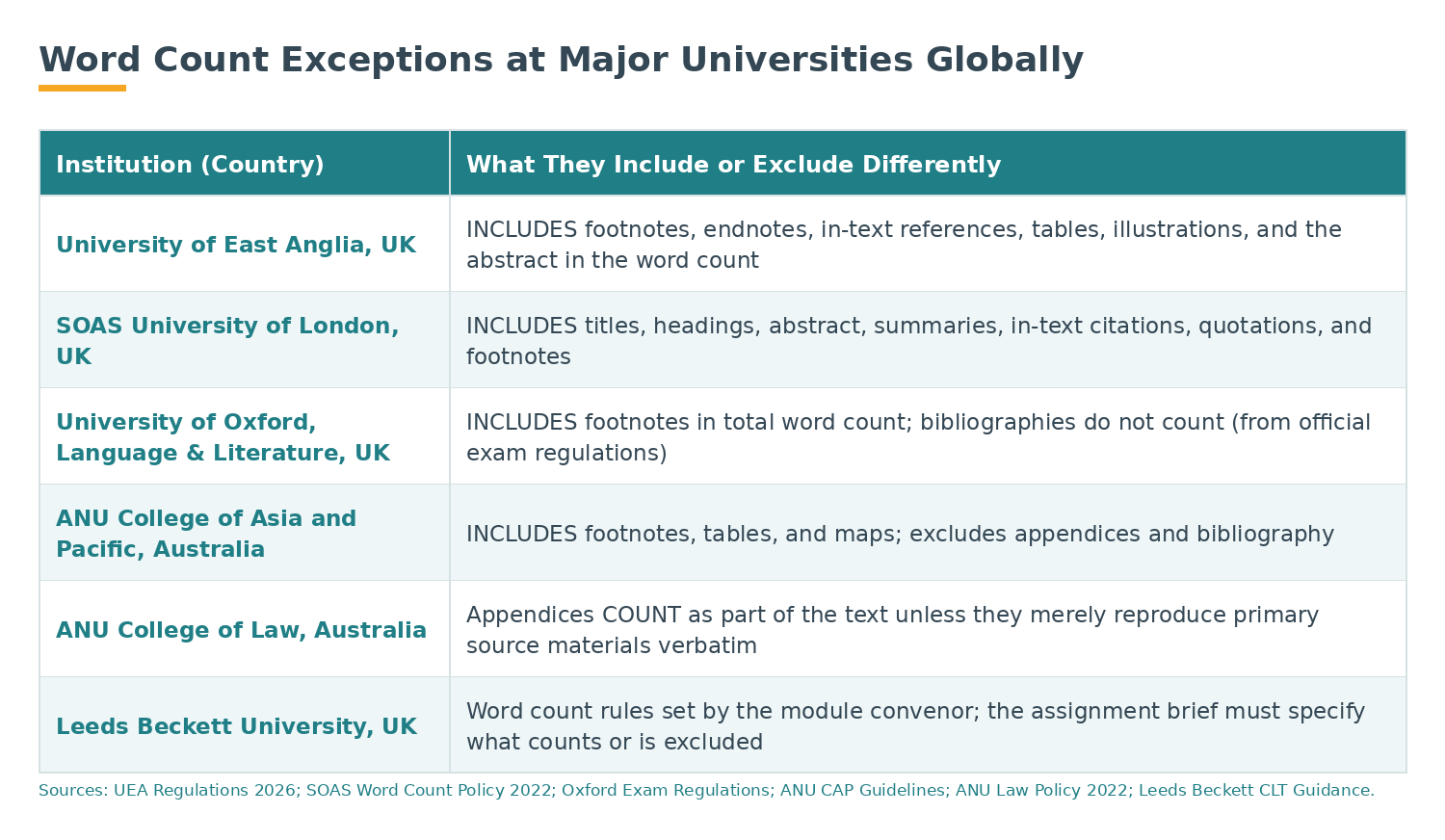
Why do these differences exist? In humanities subjects where footnotes carry substantive academic argument, counting them prevents students from moving analysis out of the main text to avoid the limit. In science and social science, where footnotes are rare or citation-only, exclusion is logical. In law, OSCOLA places all citations in footnotes, which is why most law schools exclude them. The variation reflects disciplinary norms, not inconsistency.
The Rule That Overrides Everything
Your assignment brief is the only authoritative source for your specific submission.
Leeds Beckett University's institutional guidance on setting word limits states that submission guidelines must "clarify whether bibliographic references, in-text quotes and footnotes are part of or excluded from the total word count." This is guidance to teaching staff, confirming that universities expect variation and require the brief to resolve it.
The University of Worcester's guidance notes explicitly state: "There are exceptions to this, but if there is an exception it should be explained in your assessment brief."
If your brief does not specify and your module handbook does not clarify, contact your module tutor before submission. The cost of asking is zero. The cost of guessing wrong is a word count penalty or a failed submission.
You May Also Find Useful
Frequently Asked Questions
Do references count in the word count at UK universities?
No, at virtually all UK universities as a default. The reference list or bibliography appears after the main body and is excluded as standard. Exceptions apply where an assignment brief specifies otherwise, as Leeds Beckett's guidance makes clear.
Do references count in the word count at Australian universities?
No, as the default. ANU College of Asia and the Pacific explicitly excludes the bibliography. One exception is the ANU College of Law, where appendices are generally treated as part of the text unless they merely reproduce primary source materials verbatim.
Do references count at US universities?
US universities do not have a single national policy, since word count rules are set at the course or department level. The standard convention, consistent with most US writing centers and course syllabi, is that reference lists are excluded from the word count. Students at US universities should confirm the specific rules in their course syllabus or with their instructor.
Do references count at universities in the UAE, South Africa, Singapore, or Canada?
Institutions in these countries that follow UK or Australian academic conventions apply the same standard: reference lists and bibliographies are excluded. Confirm in your assignment brief, since individual institutions and programs set their own policies.
Why are footnotes counted at some universities but not others?
The difference reflects disciplinary conventions. In humanities subjects, footnotes often carry substantive analysis and argument, so including them prevents students from using footnotes to extend their effective word count. In law, footnotes are primarily citations, so excluding them avoids penalizing detail-heavy OSCOLA referencing. Check your faculty and program policy rather than applying a general rule.
If I move content into an appendix, does it stop counting?
Not reliably, and not safely. Most universities exclude appendices from the word count only when they contain supplementary material, not essential content. SOAS and the Open University both state explicitly that content essential to your argument belongs in the main text. At ANU College of Law, appendices count unless they merely reproduce primary source materials. Moving the analysis to an appendix to reduce your word count is risky.
Do figures, charts, and graphs count in the word count?
No, if they contain only simple labels, axis titles, and brief captions. Yes, if they contain explanatory text, analysis, or detailed descriptive content. The Open University test: if you expect to receive marks for the writing, it counts.
What about in-text citations in APA or Harvard style?
Yes, in-text citations are counted as part of the main body. The text "(Smith, 2023, p. 45)" is four words that appear in your main text and are included in your word count. This is confirmed by UEA's regulations, which explicitly include "references (in the main text)" in the word count, and by UWE Bristol's referencing guidance.
What happens if my brief does not specify?
Apply the standard convention for your institution: exclude the reference list, bibliography, and appendices; include the main body, including in-text citations. If you are uncertain about footnotes or tables, email your module tutor before submission with a specific question.
When the Word Count Is the Last Thing on Your Checklist
Checking what counts toward your word limit this close to submission usually means the paper is nearly complete, or over-length, and running out of time to fix it. If your submission is above the limit and you are not sure what to cut, formatted incorrectly for your institution's specific requirements, or needs a final proofread before you submit, ScribeLab Writer's editing and proofreading service trims over-length papers without cutting the argument, reformats submissions to institutional specifications, and returns work on tight turnarounds for students across the US, UK, Australia, UAE, and internationally.