
Academic writing is a formal, evidence-based style of writing used across colleges and universities to communicate ideas, arguments, and research findings. It is the primary mode of assessment at every level of higher education, from freshman composition at UCLA to doctoral dissertations at Harvard. Understanding what academic writing is, how it works, and what distinguishes strong academic writing from weak academic writing is one of the most practical skills any student can develop.
This guide covers every dimension of academic writing that matters for your coursework: its defining characteristics, the main types you will encounter, how academic writing differs across disciplines and degree levels, the most common mistakes students make, and specific strategies you can apply today to improve your writing and your grades.
What Is Academic Writing? A Clear Definition
Academic writing is a formal style of written communication used in educational and scholarly settings to present information, analyze evidence, and construct arguments. The University of Southern California's writing center defines it as "a style of expression that researchers use to define the intellectual boundaries of their disciplines and specific areas of expertise," characterized by a formal tone, precise word choice, and evidence-based reasoning.
There are two broad categories of academic writing. The first is student academic writing, which includes essays, research papers, dissertations, reports, and other assignments submitted for assessment at high school, college, and graduate levels. The second is expert academic writing, which refers to work produced by researchers and scholars for publication in peer-reviewed journals, books, and academic proceedings.
Both categories follow the same core standards. The difference lies in the depth of original research required and the formality of the review process, not in the underlying principles of clarity, precision, evidence, and structure that define academic writing at every level.
What Are the Key Characteristics of Academic Writing?
Academic writing is distinguished from other forms of writing by a consistent set of features. These are not stylistic preferences. They are the standards that professors, graders, and academic reviewers apply when evaluating your work.
Formal tone and register:
Academic writing uses formal language throughout. This means avoiding contractions (write "do not" rather than "don't"), slang, colloquialisms, and overly casual phrasing. At institutions like MIT, Stanford, and NYU, written assignments are evaluated partly on the appropriateness of the register, which refers to the level of formality your language communicates. A paper submitted to a professor is not a text message or a blog post. The language should reflect the seriousness of the intellectual work being presented.
Third-person perspective and objectivity.
The default voice in most academic writing is third-person. Rather than "I think this policy is harmful," you write "This policy produces harmful outcomes, as evidenced by..." The shift from first-person assertion to third-person evidence-based statement is not merely stylistic. It signals that your argument is grounded in evidence rather than personal opinion. Some disciplines, including nursing and education, increasingly accept first-person writing where reflective writing is explicitly required. Always follow your instructor's or institution's guidelines.
Evidence-based argumentation:
Every claim in academic writing must be supported by credible evidence. At the University of Michigan and UC system schools, writing rubrics consistently evaluate whether students cite peer-reviewed sources, use evidence appropriately, and distinguish between their own analysis and the ideas of others. Opinion presented without evidence is not an academic argument. Evidence without analysis is not academic writing either. The skill lies in weaving sources and original thinking together to advance a clear, defensible position.
Precise and discipline-specific language.
Academic writing uses exact language. Vague words like "many," "some," or "a lot" are replaced with specific figures, qualified statements, or sourced claims. Each academic discipline also has its own vocabulary. A nursing student writing about patient outcomes uses different terminology than a sociology student writing about structural inequality, but both are expected to use disciplinary language accurately and consistently.
Clear and logical structure.
Academic papers follow predictable structures because structure serves the reader. An introduction states the argument, body paragraphs develop it with evidence and analysis, and a conclusion synthesizes the findings without introducing new material. Research papers and dissertations follow an expanded version of this structure, with sections for literature review, methodology, results, and discussion that follow field conventions. Purdue University's Online Writing Lab, one of the most cited academic writing resources in the United States, states that organization and clarity of structure are among the primary factors in grading academic work.
Proper citation and attribution.
All sources used in academic writing must be cited using the citation style required by your institution or discipline. APA 7th edition is standard in psychology, education, nursing, and social sciences. MLA 9th edition is standard in literature, humanities, and language studies. The Chicago style is used in history, philosophy, and some social sciences. Failing to cite sources correctly is not a minor formatting error. It is a matter of academic integrity. Plagiarism policies at institutions including Harvard, Stanford, and NYU carry consequences ranging from course failure to expulsion.
Critical thinking and original analysis.
At the college and graduate levels, summarizing what others have said is insufficient. Academic writing requires you to evaluate, analyze, and interpret the evidence you present. This means identifying the strengths and limitations of sources, comparing competing arguments, and developing your own reasoned position. A 2024 literature review in a research journal on academic writing challenges found that difficulty in analysis and argument construction is consistently identified as the primary obstacle students face, more frequently cited than grammar or vocabulary problems.
What Are the Main Types of Academic Writing?
Understanding which type of academic writing you are being asked to produce is the first step in meeting your assignment requirements. Each type has a specific purpose, structure, and set of conventions.
Table 1: Types of Essays and Academic Papers
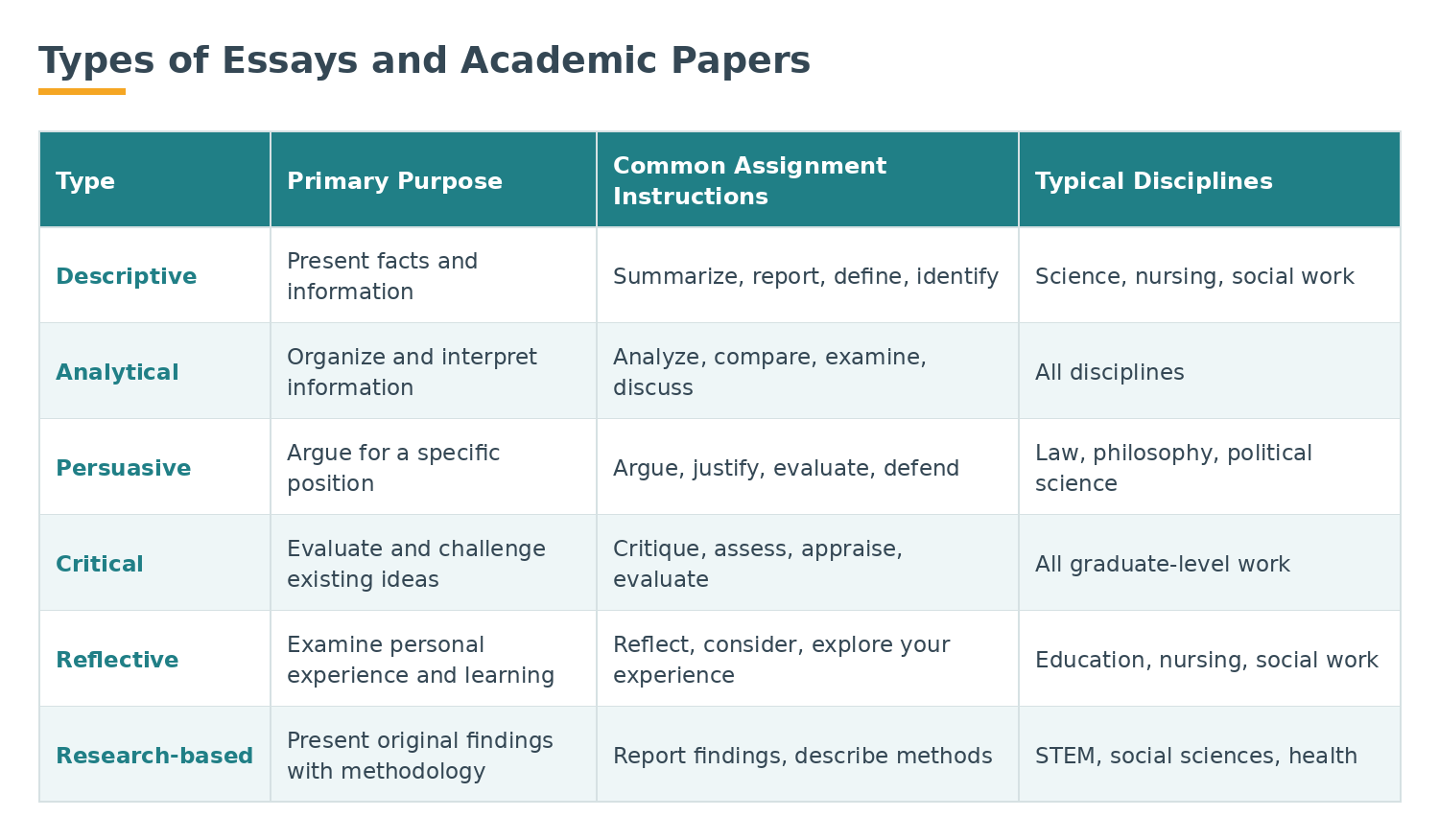
The University of Sydney's academic skills resources identify four core types of academic writing: descriptive, analytical, persuasive, and critical. Most undergraduate assignments combine more than one type. A typical research paper, for example, is simultaneously descriptive (reporting what existing literature says), analytical (organizing that literature into categories), and persuasive (arguing for a specific conclusion based on the evidence).
How Does Academic Writing Differ by Degree Level?
The expectations for academic writing shift substantially between high school, undergraduate study, and graduate programs. Understanding these differences helps you target your effort appropriately at each stage.
High school writing
High school essays are primarily evaluated on the ability to present information clearly and support a basic argument with evidence. The five-paragraph essay structure is common. Source requirements are less stringent, and the depth of analysis expected is relatively limited.
Undergraduate writing (Associate's and Bachelor's degrees)
Undergraduate academic writing requires stronger engagement with scholarly sources, a clearer, more defensible thesis, and more sophisticated analysis. At institutions like UCLA, the University of Michigan, and schools across the UC system, undergraduate papers are expected to demonstrate critical thinking, not merely information presentation. Word counts typically range from 1,500 to 5,000 words, depending on the assignment. APA, MLA, or Chicago citation is required consistently.
Graduate writing (Master's degrees)
Master 's-level writing requires deeper engagement with the academic literature, a more nuanced thesis, and a higher standard of argumentation. Literature reviews at the Master's level are expected to be comprehensive rather than illustrative. The student is expected to situate their argument within the existing scholarly conversation, rather than merely referencing a few supporting sources. Methodological awareness, which means understanding why certain sources are more credible than others and being able to articulate that judgment, becomes increasingly important.
Doctoral writing (PhD and professional doctorates)
Doctoral-level writing is the most demanding because it is expected to make an original contribution to knowledge. A dissertation at Harvard, MIT, Stanford, or equivalent institutions must not only synthesize existing research but also identify a genuine gap in the literature and produce original findings or arguments that advance the field. The writing standard is that of a publishable academic document. Precision, rigor, and scholarly voice are non-negotiable.
How Does Academic Writing Differ Across Disciplines?
The conventions of academic writing vary by field. Knowing your discipline's norms prevents avoidable mistakes and signals to your professor that you understand the scholarly community you are writing for.
Humanities (literature, history, philosophy, languages)
Humanities writing tends to be argument-driven and interpretive. MLA citation is common in literature programs. Historical and philosophical writing often uses the Chicago style. First-person is sometimes appropriate depending on the genre. Close reading of primary texts is central.
Social sciences (sociology, psychology, political science, economics)
Social science writing follows the APA format in most US programs. It relies heavily on empirical research, quantitative and qualitative data, and the presentation of methodology. Papers must clearly distinguish between what the evidence shows and what the author concludes from that evidence.
Natural and applied sciences (biology, chemistry, engineering, computer science)
Scientific writing follows IMRAD structure: Introduction, Methods, Results, and Discussion. Passive voice is more commonly used than in other disciplines. An IEEE citation is common in engineering and computer science. Precision in describing methodology and results is the primary standard.
Health and nursing
Nursing and health sciences writing uses APA format and is expected to integrate evidence-based practice standards. Clinical judgment must be supported by peer-reviewed research. Reflective writing, including personal clinical experience analyzed against theoretical frameworks, is a common assignment type at US nursing programs.
Business and management
Business writing at the undergraduate level is often more practical and report-oriented. MBA-level writing is more analytical, requiring evaluation of business decisions, financial data, and organizational theory with scholarly sources. Harvard Business School case method writing has influenced MBA writing conventions across US institutions.
Law
Legal writing is its own discipline with specific conventions. IRAC structure (Issue, Rule, Application, Conclusion) is standard for legal memos and briefs. Citation follows Bluebook or ALWD format. Arguments must be structured with precision and every claim grounded in precedent, statute, or established legal principle.
What Are the Most Common Academic Writing Mistakes?
Research on student writing consistently identifies the same categories of error. Knowing them gives you a specific checklist to work from before submitting any assignment.
Thesis problems
The most common thesis mistake is writing a topic statement rather than an argument. "This paper discusses the impact of social media on mental health" is a topic statement. "Adolescents who use social media platforms for more than three hours daily show statistically significant increases in anxiety symptoms, suggesting a dose-dependent relationship that existing regulatory frameworks fail to address" is a thesis. A strong thesis makes a specific, defensible claim that the rest of the paper will prove.
Poor paragraph structure
Each body paragraph should contain a topic sentence that states the paragraph's main point, evidence that supports it, analysis of that evidence, and a transition that connects the paragraph to what follows. Papers that simply list evidence without analysis receive low grades at every institution because they demonstrate information retrieval rather than intellectual engagement.
Over-quoting and under-analyzing
A paragraph that is mostly a quotation is a paragraph that has done someone else's work for them. Academic writing requires you to use sources as evidence for your own argument, not as a substitute for making one. As a general rule, a direct quotation should be followed by at least as much analysis as the quotation itself.
Incorrect citation
APA, MLA, and Chicago each have specific rules for in-text citation and reference list formatting. Common errors include missing page numbers on direct quotations, incorrect author-date formatting, mismatched in-text citations and reference lists, and failure to cite paraphrased material. Purdue OWL provides free, detailed citation guidance for every major style and is the resource recommended by writing centers at institutions across the US.
Informal language
Contractions, first-person opinion statements, slang, and casual phrasing all undermine the credibility of academic writing. The shift from informal to formal register is one of the first adjustments students must make when entering college, and one of the most persistent problems professors identify in undergraduate essays.
Weak introductions and conclusions
An introduction that spends two paragraphs providing general background before arriving at a thesis wastes the reader's time and buries the argument. A conclusion that simply restates what was said without synthesizing or extending the argument adds no value. Both sections are high-leverage: they are what professors read first and last, and they shape the paper's overall impression.
Insufficient engagement with counterarguments
A persuasive or argumentative paper that never acknowledges the strongest objection to its position appears one-dimensional. Engaging with counterarguments and demonstrating why the evidence favors your position despite them is a mark of sophisticated academic writing.
How to Improve Your Academic Writing: A Practical Step-by-Step Guide
These are specific, actionable steps you can take to improve your academic writing immediately.
Step 1: Read your assignment brief carefully and identify what type of writing is required. Before writing a word, determine whether you are being asked to describe, analyze, argue, evaluate, or reflect. The assignment instructions contain keywords that tell you exactly what intellectual task is expected. Misreading the assignment type is the single most avoidable reason for poor grades.
Step 2: Develop a thesis before you begin drafting. Your thesis should be a specific, arguable claim that answers the essay question directly. Write it in one or two sentences before you begin. If you cannot state your argument clearly before writing, you will not be able to develop it clearly in the paper.
Step 3: Build an outline before you write. An outline organizes your argument and ensures that each paragraph has a clear purpose that advances the thesis. It takes fifteen minutes and saves hours of revision. Map each body paragraph to a specific piece of evidence and its analysis.
Step 4: Use your institution's academic databases for sources. US universities provide access to JSTOR, EBSCOhost, PubMed, ProQuest, and Google Scholar through their library portals. Peer-reviewed articles from these databases are the appropriate sources for academic writing. Wikipedia, news articles, and general websites are not appropriate as primary academic sources, though they can help you identify issues and locate credible sources.
Step 5: Write a complete first draft without editing. Attempting to write and edit simultaneously slows you down and produces fragmented prose. Write your draft from the introduction to the conclusion without stopping to polish sentences. You can revise once the argument is on the page.
Step 6: Revise for argument before editing for language. After drafting, read for logic and structure first. Does each paragraph support the thesis? Does the argument progress logically? Are your claims supported by evidence? Are your transitions clear? Fix structural problems before worrying about sentence-level editing.
Step 7: Check your citations against the required style guide. Before submitting, verify every in-text citation against its entry in your reference list. Use Purdue OWL for APA and MLA guidance. Use the Chicago Manual of Style online for the Chicago format. Citation errors are preventable and cost grades.
Step 8: Read your draft aloud before submitting. Reading aloud catches awkward phrasing, missing words, run-on sentences, and unclear transitions that your eyes skip when reading silently. It is one of the simplest and most effective revision techniques.
Step 9: Use your institution's writing center. Most US universities provide free writing center appointments for undergraduate and graduate students. The writing center at Harvard, MIT, Stanford, UCLA, NYU, and institutions across the UC system all offer in-person and online consultations. Writing center tutors can review drafts, help you develop your thesis, and provide feedback on argument structure and citation.
Step 10: Allow time for a final proofread after a break. Submit your final version after at least a few hours away from the paper. Distance from your own writing helps you catch errors you would otherwise overlook.
Academic Writing Checklist Before You Submit
Use this checklist before submitting any academic paper:
The thesis is specific, arguable, and clearly stated in the introduction
Every body paragraph has a topic sentence, evidence, and analysis
All claims are supported by credible, properly cited sources
Citation style matches the required format throughout (APA, MLA, Chicago, or other)
The reference list is complete and formatted correctly
Formal register maintained throughout, no contractions or slang
Introductory paragraph clearly previews the argument
Conclusion synthesizes rather than just restates
The paper addresses the strongest counterarguments where relevant
Word count meets the assignment requirements
Submitted as the correct file type and file name per your professor's instructions
Academic Writing for International Students at US Institutions
Students from the UAE, Saudi Arabia, and Asian markets studying at US universities or applying to US, UK, or Australian graduate programs face specific challenges that domestic students typically do not.
The most common challenge is the difference in academic writing conventions between educational systems. In many international education systems, extensive use of quotations from authoritative sources is considered a mark of scholarly engagement. In US academic culture, by contrast, the expectation is that you paraphrase, analyze, and synthesize sources rather than quote them extensively. This shift requires deliberate adjustment.
A second frequent challenge involves the directness expected in US academic argumentation. Some international academic traditions favor a more indirect presentation of claims. US academic writing typically requires that the thesis and main argument be stated explicitly and early, often in the first paragraph of the introduction.
Citation conventions are also unfamiliar territory for many international students. APA, MLA, and Chicago formats do not exist in all educational systems, and mastering them takes time and practice. Purdue OWL's citation guides are the most widely used free reference for international students learning US citation standards.
For international students at US institutions, most universities offer academic writing support through their international student offices and writing centers, in addition to the general writing support available to all students.
Frequently Asked Questions About Academic Writing
What is the difference between academic writing and other types of writing? Academic writing is distinguished from other writing by its formal register, evidence-based argumentation, precise language, citation requirements, and structured organization. Unlike creative writing, which prioritizes expression and originality of form, academic writing prioritizes clarity of argument and fidelity to evidence. Unlike journalistic writing, which aims for accessibility and speed, academic writing aims for precision and scholarly rigor.
What citation style should I use for academic writing? The citation style you use depends on your discipline and your institution's requirements. APA 7th edition is standard in psychology, education, nursing, business, and social sciences. MLA 9th edition is standard in literature, languages, and humanities. Chicago style is common in history and some social sciences. Your professor's syllabus will specify which style is required. When in doubt, ask your professor or consult your institution's library website.
How long should an academic paper be? The length of an academic paper is determined by the assignment, not by a universal standard. Undergraduate essays at US universities typically range from 1,500 to 5,000 words. Graduate seminar papers range from 5,000 to 10,000 words. Master's theses vary widely by program and discipline, commonly ranging from 15,000 to 50,000 words. Doctoral dissertations range from 60,000 to 100,000 words or more, depending on the field. Always follow the word count specified in your assignment brief.
Can I use the first person in academic writing? The convention in most academic disciplines is to use the third-person perspective to maintain objectivity. However, some disciplines, including reflective nursing practice, education, and certain social sciences, explicitly require a first-person perspective, with personal experience as part of the assignment. Check your assignment guidelines and follow your institution's specific conventions. When in doubt, use the third person.
What makes a strong thesis statement in academic writing? A strong thesis statement is specific, arguable, and directly responsive to the essay question. It makes a claim that the paper will prove through evidence and analysis. A weak thesis is a statement of fact or a description of what the paper will cover. A strong thesis takes a clear position and identifies the basis for that position. For example: "Federal student loan policies disproportionately burden Black and Hispanic graduates relative to white graduates, reflecting structural inequities in how higher education financing interacts with pre-existing wealth gaps."
What is the difference between a research paper and an essay? An essay typically develops an argument based on secondary sources and the student's analysis. A research paper involves original or secondary research, a methodology, and a more formal structure that includes a literature review. At the undergraduate level, the distinction is often blurred. At the graduate level, research papers are expected to contribute to existing scholarly conversations in a way that essays are not always required to do.
How do I avoid plagiarism in academic writing? Plagiarism is avoided by citing every source you use, whether you quote directly or paraphrase. Direct quotations require quotation marks and an in-text citation including the page number. Paraphrased material requires an in-text citation even though the wording is your own. Ideas that are not common knowledge must be cited even if you encountered them in one source and confirmed them in another. If you are unsure whether something needs to be cited, cite it. Submitting your paper through your institution's plagiarism detection system, such as Turnitin, before the final submission is a practical safeguard available at most US universities.
What is an academic writing style guide? An academic writing style guide is a set of standardized rules for formatting, citing, and documenting academic writing. The major style guides are the Publication Manual of the American Psychological Association (APA), the MLA Handbook for Writers of Research Papers (MLA), the Chicago Manual of Style, and the Harvard referencing style. Style guides specify how to format in-text citations, reference lists, headers, margins, fonts, and other elements of document presentation.
How ScribeLabWriter Supports Academic Writing at Every Level
Academic writing is a skill, and like any skill, it develops with guidance, practice, and feedback. ScribeLabWriter provides custom academic writing support for undergraduate, Master's, and PhD students across all disciplines, including essays, research papers, dissertations, literature reviews, case studies, term papers, and more.
Every paper we produce is written from scratch by a qualified human writer, never AI-generated, and checked for plagiarism before delivery. Our writers hold advanced degrees, and many have direct experience as academics, which means they understand the specific standards your professor or institution applies.
If you are struggling with your thesis, stuck on a literature review, facing a tight deadline, or simply not confident in your academic writing, we can help.
Get a Quote or explore our academic writing services.